
















































Echo Protocol hack on Monad tests DeFi bridge risk
The Echo Protocol hack on Monad reads like a DeFi control failure, not a Monad failure. My take: this is the part traders should not blur. The reported loss was 385 ETH, worth about $816,000. The route was messy but readable: the attacker used 45 eBTC as collateral to borrow about 11.29 WBTC. Why does this matter? Because bridge and lending risk can hit ETH, WBTC, eBTC, and other collateral before the market prices it in. Fast damage. Slow repricing.
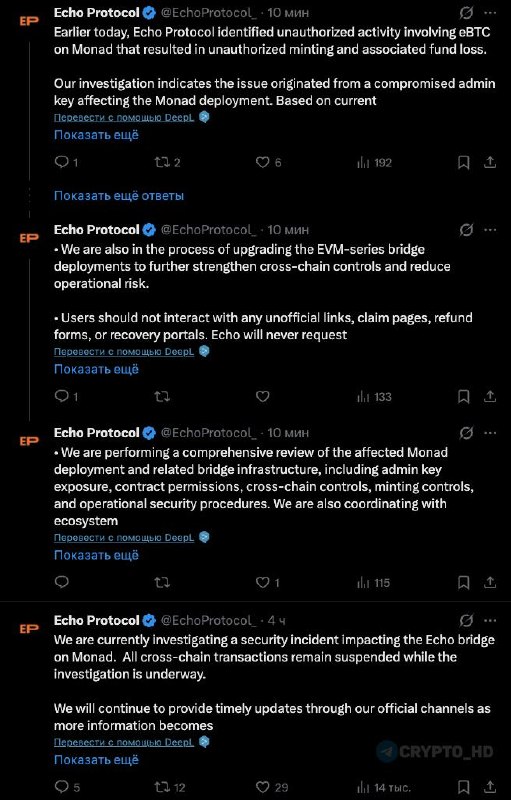
According to the source post, the attacker compromised the admin key for the eBTC contract on Monad and minted 1000 eBTC from nothing. Then came the six-step cash-out: deposit 45 eBTC into Curvance, borrow about 11.29 WBTC, move the funds to Ethereum, swap into ETH, and send 385 ETH, about $816,000, to Tornado Cash. Echo reportedly recovered the keys quickly and burned the attacker’s remaining 955 eBTC. The source puts the real protocol loss at $816,000. Monad kept running normally.
This is not a tiny DeFi footnote, even if the dollar amount is modest by crypto standards. Most guides say to focus on exploit size. That is only half right. The trade route tells the better story: eBTC to Curvance to WBTC to Ethereum to ETH to Tornado Cash. For ETH traders, 385 ETH is not enough to move the whole market on its own. The structure is the problem. If users start discounting bridged collateral or assets controlled by admin keys, liquidity can leave lending markets before token prices fully show the stress.
BTC may trade like a hedge, but wrapped and synthetic BTC are a different thing. I will be blunt: treating them as the same exposure is lazy risk work. Native BTC has one risk profile. WBTC and eBTC add contracts, bridges, governance, and human control. In this case, about 11.29 WBTC was borrowed against 45 eBTC, then routed into ETH and Tornado Cash. Nothing here suggests Bitcoin settlement was compromised. Still, I would not treat DeFi BTC exposure as the same as holding native BTC. Wrapped collateral can carry chain risk, bridge risk, lending risk, admin key risk. All at once.
Regulators notice when an exploit involves admin keys, cross chain movement, lending collateral, and a privacy mixer. Tornado Cash is listed in the source as the final stop for 385 ETH, about $816,000. That detail may matter more to compliance teams than the size of the loss. One flow touched four sensitive areas: an admin key, a bridge path, a lending market, and a mixer. That is an enforcement slideshow waiting to happen. After incidents like this, the SEC, CFTC, and law enforcement usually get less patient with DeFi control claims, even when the team moves quickly afterward.
Echo’s response limited the remaining damage, but it did not erase the original problem. The source says Echo regained control and burned 955 eBTC, which stopped the attacker from using the full 1000 eBTC mint. Good containment. Bad starting point. Real liquidity was already gone: 45 eBTC became about 11.29 WBTC, then 385 ETH, then Tornado Cash. Traders should separate cleanup from prevention. Recovering the key quickly helped. The key still allowed 1000 eBTC to be minted in the first place.
Monad continuing to operate normally is an important distinction for Layer 1 investors. The source says Monad did not suffer and kept operating as usual. A protocol exploit on Monad is not the same as a Monad consensus failure. Yes, this sounds like splitting hairs. It is not. Markets do not always separate those cleanly in the first few hours. New chain ecosystems run on confidence. Bridges and lending markets matter almost as much as block production. Collateral standards sit right beside them. If cross chain operations on Monad stay paused, capital becomes less useful even if the base chain keeps producing blocks.
The response went beyond one bad transaction. The source says Monad cross chain operations were halted, contracts were updated, and Aptos bridge and lending were paused as a precaution. Other bridge upgrades are reportedly in progress. That tells investors the team sees a wider attack surface here. The affected pieces include Monad, Aptos, eBTC, Curvance, WBTC, and ETH routing. Is this overkill? For a live bridge and lending stack, no. For DeFi users, the better question is not only “how much was lost?” It is “which markets are frozen while this gets fixed?”
In DeFi, liquidity often matters more than the macro story people want to tell. I keep coming back to this because it is where the actual damage spreads. When traders stop trusting collateral, they usually move away from yield positions and back toward spot exposure or stablecoins. The direct loss here is $816,000. The bigger signal is the list of pauses: Monad cross chain operations stopped, Aptos bridge and lending paused, and bridge upgrades were still underway. That can mean less borrowing, slower collateral turnover, and weaker DeFi beta compared with plain ETH or BTC spot.
The numbers are the cleanest way to read the risk. ETH had the exit flow: 385 ETH. WBTC supplied the borrowed liquidity: about 11.29 WBTC. eBTC carried the mint problem: 1000 eBTC minted, 45 eBTC used, 955 eBTC burned. Monad got the ecosystem headline. Aptos got the precautionary pause. Five buckets. Five different meanings. Track them separately.
The source also mentions “Yesterday: Verus,” but gives no details. I would not treat that as a confirmed second incident based on this source alone. Counter to the usual crypto panic loop, the correct move is to narrow the claim, not enlarge it. Still, the timing matters in a narrower market sense. Traders are seeing repeat exploit headlines, not carefully separated balance sheets. If two names show up in back to back Telegram style alerts, risk teams often raise haircuts first and ask sharper questions later. That makes DeFi liquidity more expensive.
The market will judge Echo’s response in two ways: fast containment, or evidence that admin key risk was too concentrated. There is no direct quote in the source, so there is no reaction to attribute. The available facts are enough. Echo reportedly recovered the keys, burned 955 eBTC, paused Monad cross chain operations, paused Aptos bridge and lending, updated contracts, and started upgrades on other bridges. Users now have to decide whether that looks like competent incident handling or a warning that too much power sat behind one key.
What this means
This event shows that DeFi’s weak spot is still operational control: admin keys, synthetic collateral, and bridge linked lending. The $816,000 protocol loss is smaller than many past exploits, but the route touched sensitive tickers: ETH, WBTC, and eBTC. My read: eBTC takes the credibility hit first, even if Monad kept running normally. Watch whether Echo restores Monad cross chain operations and Aptos bridge and lending after the contract upgrades. Until then, eBTC collateral probably deserves a credibility discount anywhere traders price admin key risk.
The next thing to watch is Echo’s next dated update after May 19, 2026. Traders need confirmation that Monad cross chain operations, Aptos bridge functions, and lending markets are back online. The first levels to watch are not chart lines. They are the exploit balances: 45 eBTC used, about 11.29 WBTC borrowed, 385 ETH exited, and 955 eBTC burned. If any bridge upgrade slips, ETH and WBTC liquidity in connected DeFi markets may stay cautious, even while Monad itself keeps running normally.