
















































Korean Funeral Company Ethereum Loss Puts BMNR Leverage Under Scrutiny
The Korean funeral company Ethereum loss sounds almost made up at first. Then it gets ugly. As of May 19, 2026, Korean funeral company Bumo Sarang had reportedly lost client money after putting about 59,5 млрд. вон into a 2x leveraged ETF tied to BitMine shares, ticker BMNR. The position fell to roughly 10,2 млрд. вон. That means a 49,3 млрд. вон loss, or около $33m. My take: this is the kind of crypto-adjacent blowup people ignore until the money belongs to regular customers. ETH weakness is no longer only a trading screen problem. It may now decide whether prepaid funeral money comes back.
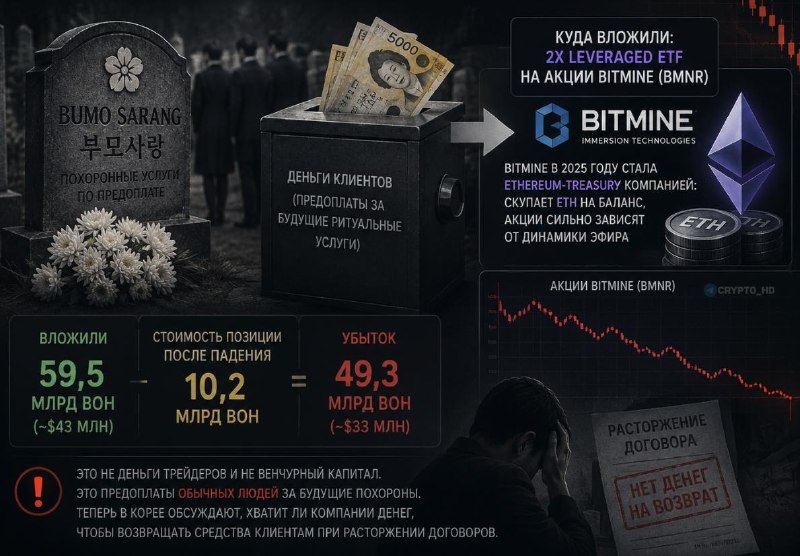
Bumo Sarang took client prepayments for future funeral services and put those funds into a 2x leveraged ETF on BitMine. BitMine trades under BMNR, and market talk links the stock to the company’s ETH balance. The source post does not give a trade date, an ETH price, or the size of BitMine’s own position. That limits the story. But the numbers do not need much dressing up: 59,5 млрд. вон went in, about 10,2 млрд. вон remained after the market fell, and 49,3 млрд. вон disappeared. That is an implied drawdown of roughly 82.9%. Why does this matter? Because Korea is now asking the only question that counts: can Bumo Sarang return client funds if people cancel?
The market read is blunt. ETH still trades like a high beta risk asset, and 2x exposure can turn a rough week into a balance sheet problem fast. We have seen this pattern before in crypto-linked equities: the token falls, the stock overreacts, the wrapper magnifies it, then everyone acts surprised. When rates stay tight or traders sell growth and crypto beta, ETH-linked equities and leveraged funds can fall harder than spot ETH. BMNR is the ticker in this case. ETH is the pressure point. A drop from 59,5 млрд. вон to 10,2 млрд. вон shows how a leveraged wrapper can turn price swings into solvency stress, especially when the money came from customers instead of a fund desk.
The regulatory angle is more direct than the usual BTC or ETH ETF debate. Korea is discussing whether Bumo Sarang can meet refund obligations. That moves the story from “bad trade” to “why did prepaid funeral money end up in a 2x leveraged BMNR product?” Crypto traders should pay attention. Most guides say product risk is mainly about volatility. That is only half right. After a public loss, regulators usually look at the product and how it reached the buyer. If a funeral company can lose около $33m through ETH-adjacent leverage, watchdogs have a simple case to make: complex crypto-linked products reached the wrong buyer, using the wrong money, just before the market turned.
To be clear, this is not a claim that ETH alone caused the full 49,3 млрд. вон loss. The source says Bumo Sarang invested in a 2x leveraged ETF on BitMine shares, BMNR, and says the damage followed a market decline tied to Ethereum’s fall. That distinction matters. Spot ETH, ETH treasury stocks, crypto miners, exchange shares, and leveraged ETFs are different instruments. They may move together. They do not carry the same risk. I will be honest: traders sometimes flatten all of this into “ETH exposure” because it is faster. The funeral company case shows why that shortcut breaks when exposures get stacked and someone still treats it like a simple ETH bet.
For BTC and ETH markets, the lesson is familiar: leverage leaks. It does not stay inside the product brochure when prices fall. In 2024, spot BTC ETFs made institutional access cleaner. Spot ETH ETFs later pushed Ethereum further into mainstream portfolios. That is context, not a new fact from the source. Counter to the usual advice, “regulated wrapper” does not automatically mean safer exposure. It often just means cleaner access to the same volatility, plus a few extra layers. BMNR sits in that messy middle now. ETH traders should watch whether forced selling, fund rebalancing, or reputation damage around ETH-linked leverage hits related equities before it appears in spot order books.
There is a safe haven angle too, although this is not a war, sanctions, or bank panic story. BTC often gets called “digital gold” when markets get tense. ETH usually trades more like tech beta, with extra sensitivity to on-chain growth expectations. The Bumo Sarang case makes that split harder to ignore. A Korean customer who prepaid for future funeral services probably does not care whether the exposure was ETH, BMNR, or a 2x ETF. They care that 59,5 млрд. вон in promised service funding may now be worth about 10,2 млрд. вон. Is that too simple? No. Headlines like that can make retail buyers step back from complex crypto-linked products.
The market link is sharper because BMNR is an equity ticker, not a token. Crypto investors now trade the ecosystem through public market wrappers: COIN for exchange revenue, miners for BTC exposure, treasury names for coin exposure. Leveraged ETFs sit on top of that. This case shows why that chain matters. If ETH falls, a related equity can fall. If BMNR falls, a 2x ETF can fall harder. If that ETF sits on a non-financial company’s books, the loss turns into a public trust problem. By May 19, 2026, that is the debate taking shape around Bumo Sarang in Korea.
The source includes no quote, so there is no quote to add. Good. The point does not need one. Bumo Sarang reportedly put client prepayments into a 2x leveraged BMNR ETF and now faces refund questions after a 49,3 млрд. вон loss. That number is specific enough to spread. Regulators remember numbers like that. Traders do too. Yes, this contradicts the comforting story that institutional wrappers make crypto safer. Bear with me: they make access easier. They do not make volatility behave.
What this means
The Bumo Sarang loss gives crypto traders a concrete risk to watch in 2026. ETH exposure is moving through public equities, leveraged ETFs, and company balance sheets in ways customers may not understand until money is gone. In this case, the ticker is BMNR, the crypto link is ETH, and the reported damage is 49,3 млрд. вон, or около $33m. Watch whether the Korean discussion shifts from refund capacity to product limits. My read: that shift is the real market signal, not another clean ETH chart setup. If it happens, one company’s failed trade could become a regulatory problem for leveraged ETH-linked products.
Next, watch ETH and BMNR around the June 16-17, 2026 FOMC meeting, when risk positioning can reset across crypto, equities, and leveraged ETF flows. The technical level here is not an ETH price from the source. It is the reported 10,2 млрд. вон left in Bumo Sarang’s position against the original 59,5 млрд. вон. If another leg lower raises refund concerns in Korea, ETH traders should check CME futures positioning, BMNR liquidity, and any official Korean response before dismissing this as one bad trade. Skip the shrug.