















































Roaring Kitty Crypto Scam Shows Meme Coin Risk for Traders
A Roaring Kitty crypto scam does not need a complicated plot. It needs a familiar social account, a compromise, and a token where too much supply sits in too few hands. Late buyers usually discover the supply problem after the dump. Too late.
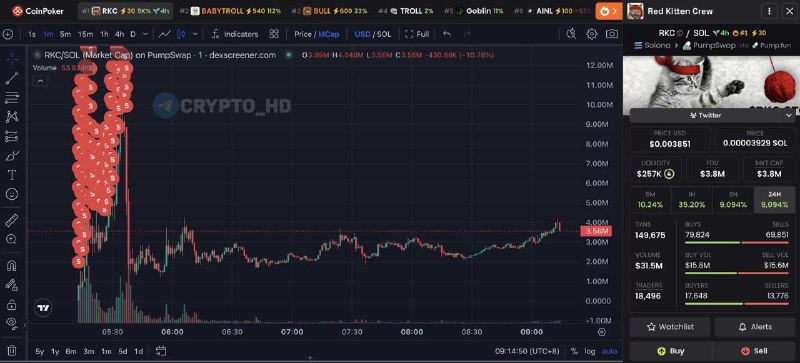
This one moved fast. A hacked Roaring Kitty account pushed a shitcoin, traders rushed in, the token developer sold into the attention, the post vanished, and the token fell about 90%. Most guides would frame that as a social-engineering story. That is only half right. The real problem was the market structure waiting underneath.
The numbers are hard to make look better. The developer behind the shitcoin had already bought 39.52% of the total supply across 10 wallets. Cost: 20 SOL, about $1,950. Later, those tokens were sold for 5,071 SOL, about $495,000. The developer also collected 1,209 SOL, about $118,000, in creator fees. Total profit for the attacker came to roughly 6,260 SOL, or about $611,000. My take: once the 39.52% figure is on the table, the rest is mostly timing.
The warning was in the market structure. A meme coin with 39.52% of supply spread across 10 wallets is not a fair launch. It is an exit waiting for buyers. This was more than another Roaring Kitty meme coin blowup. It showed SOL traders and meme coin snipers how thin these trades can get. It also gave anyone chasing influencer-linked tokens a cleaner rule: check the wallets before the chart seduces you. When one side controls that much supply and sells for 5,071 SOL, the chart does not need bad macro news, weak BTC, or a Fed surprise. The break was already sitting there.
The SEC had its own version of this problem on Jan. 9, 2024, when its official X account was compromised and posted a fake spot Bitcoin ETF approval message. The real spot Bitcoin ETF approvals came the next day, Jan. 10, 2024. That was BTC and ETF speculation. This was Roaring Kitty, SOL, and a shitcoin. Different scale. Same bad habit. Traders react first, check later. The person who set the trap gets paid in the middle.
For BTC and ETH investors, the token itself does not matter systemically. I do not think anyone serious is arguing that it does. The damage is to confidence. Every Roaring Kitty-style hack, pump, and dump makes crypto look less like a grown-up asset class and more like an attention casino with faster settlement. Why does this matter? Because BTC is trying to trade like institutional collateral while ETH is trying to keep its place as the settlement layer for serious on-chain finance. Regulators tend to notice the ugliest examples first. I’ll be honest: this is exactly the kind of headline that makes the serious crypto pitch harder.
Macro still matters, just not in the lazy “rates up, risk down” way. Loose liquidity gives SOL meme coins room to soak up wild speculation because traders feel rewarded for chasing volatility. Tight liquidity does the opposite. It turns the same setup into a faster trap. A token that drops about 90% after a deleted post is not a macro asset. It is a liquidity event with a ticker. Yes, that partly contradicts the usual macro framing. Good. This was not about CPI, payrolls, or the next dot plot. Still, these blowups can change risk appetite across SOL meme coins and move money toward or away from higher-beta crypto trades versus BTC.
The adoption problem is awkward. Fast and cheap crypto rails help real users. They also let extraction move at ridiculous speed when social attention spikes. Here, the developer spent 20 SOL, about $1,950, controlled 39.52% of supply through 10 wallets, then exited for 5,071 SOL, about $495,000. Great trade for the attacker. Awful look for everyone trying to argue that on-chain markets are cleaner and more transparent than legacy finance. That argument still has merit, but not in this example.
On-chain transparency did make the post-mortem possible. Analysts could trace the wallets, supply share, sale proceeds, creator fees, and total profit: 1,209 SOL, about $118,000, in fees, and roughly 6,260 SOL, about $611,000, overall. But that did not save late buyers. It only explained how they got hit. Is this overkill for one meme coin? No, because the same pattern keeps repeating under different tickers. Traders need discipline before the trade, not a forensic thread after the chart has already collapsed. In meme coins, the chart often becomes the disclosure document. By then, it is too late.
What this means
The Roaring Kitty crypto scam shows that influencer-linked meme coin trading is still structurally risky when social media speed, concentrated supply, and thin liquidity arrive together. Simple as that.
For SOL, the weak spot is not the base protocol. It is the meme coin risk premium around it. Counter to the usual anti-SOL take, this is not really an argument that Solana failed. It is an argument that the fastest venues attract the fastest extraction when attention spikes. If traders keep seeing Roaring Kitty-style hacked launches end in 90% drawdowns, some capital will leave fresh meme coin pairs and move back toward BTC, ETH, or better-known SOL ecosystem names with deeper liquidity.
The practical signal is distribution, not just price. Watch the next FOMC dates for risk appetite. Watch CME BTC futures positioning for institutional leverage. Watch SOL meme coin liquidity after big social-media-driven launches. The level to watch is not only on the chart. It is in the wallets. If a new Roaring Kitty meme coin or GME meme coin story shows 30% to 40% of supply clustered in a few wallets, the trade is already telling you who controls the exit. I would treat that as the headline, not the footnote.