
















































us treasury yields bitcoin pressure returns as 30-year hits 5.12%
The US 30-year Treasury yield rose to 5.12%, its highest level since the 2008 financial crisis. That drags the us treasury yields bitcoin pressure trade back onto the screen. My take: this is not subtle. When long bonds pay more, BTC has to compete harder for the same dollar. The update also points to Japan and the United Kingdom, where the same long-yield squeeze is now showing up.
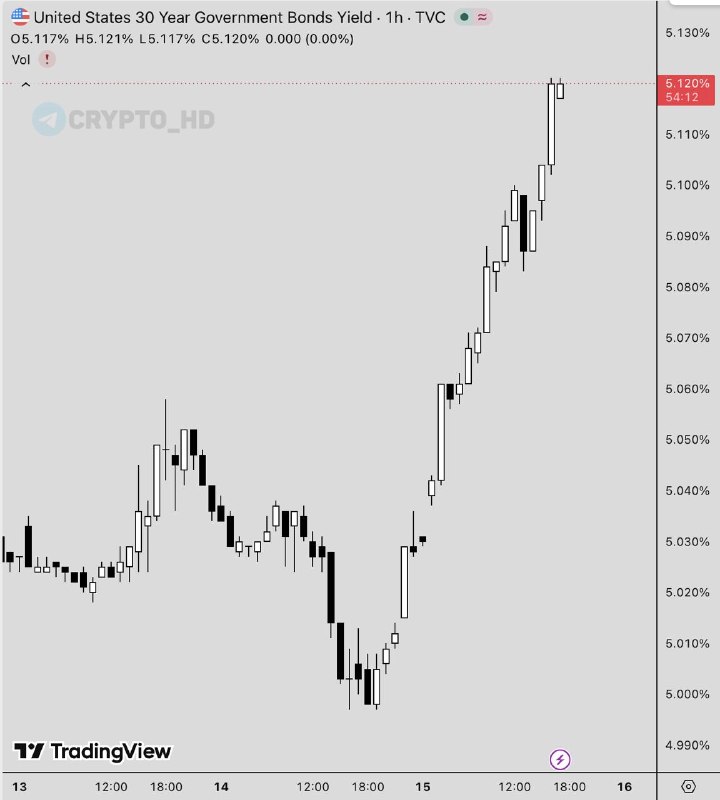
The wire update says the US 30-year government bond yield climbed to 5.12%, a level last seen around the 2008 financial crisis. It says higher US government bond yields often pressure BTC because investors can move into the dollar and bonds instead of risk assets. That matters. This is not only an American move: Japan’s 30-year bond yield moved above 4% for the first time, while the United Kingdom’s 30-year yield hit its highest level since 1998.
The macro read is pretty direct, but not as clean as the usual version. BTC often trades like a long-duration risk asset when real yields rise, even though the longer Bitcoin argument usually rests on fixed supply and currency debasement. Most guides say Bitcoin is just “digital gold.” That’s only half right. Context, not from the source: BTC reached about $69,000 in November 2021, near the top of the last liquidity cycle, then fell hard as rates repriced through 2022. Traders remember that tape. A US 30-year yield at 5.12% does not have to wreck crypto; it only has to make cash, dollars, and government bonds look less irritating than volatile beta.
This is no longer only a US rates story. Japan’s 30-year yield moving above 4% for the first time matters because Japanese capital has been tied to global carry trades and overseas bond demand for years. The United Kingdom’s 30-year yield reaching a high since 1998 adds another pressure point. Why does this matter? Because global duration stress can pull risk appetite lower even when there is no crypto-native disaster. Context, not from the source: BTC sold off during the March 2020 liquidation before recovering once emergency liquidity returned. So yes, “digital gold” sounds good. In a funding scare, though, Bitcoin can still trade like a risk asset first. I would not wave that away.
For ETH and listed crypto stocks such as COIN, the same pressure lands differently. Context, not from the source: many traders have treated ETH as higher beta than BTC, while COIN depends on trading volumes, retail appetite, and the equity market’s valuation mood. I’ll be honest: COIN is where the rates story can look brutally mechanical. When the US 30-year yield reaches 5.12%, the discount-rate math gets tougher for anything priced on future growth. Crypto still does not need the bond market to collapse before it can recover. It needs yields to stop climbing, liquidity to stop tightening, or spot demand to absorb the pressure. Not great.
What this means
This looks like a global duration selloff, not a one-country wobble. The source gives three pressure points: the US 30-year yield at 5.12%, Japan’s 30-year yield above 4% for the first time, and the United Kingdom’s 30-year yield at its highest level since 1998. For BTC, the near-term question is whether Bitcoin trades more like scarce money or like a risk asset competing with bonds and the dollar for capital. Is that contradiction annoying? Yes. It is also the trade. Watch BTC first. Then watch ETH and COIN, because stress usually reaches the most liquid crypto proxies before smaller tokens feel it.
Watch the next Federal Reserve decision date, CME rate-probability data, and the US 30-year yield itself. Counter to the usual advice, I would not start with crypto headlines here. If 5.12% keeps pushing higher, BTC may stay under macro pressure even without crypto-specific bad news. Traders should also check whether BTC holds its nearest major technical support using live exchange levels, not stale headlines. I would not brush this off: if Japan stays above 4% and UK long yields keep hovering around 1998-era highs, the dollar-and-bonds trade remains the main macro opponent for crypto risk appetite.