
















































Token unlocks May 11-17 put crypto liquidity on watch
Token unlocks are scheduled releases of crypto tokens that were previously locked. Once released, they increase circulating supply and give holders the option to sell. Simple enough. The May 11-17 window puts fresh supply back on traders’ screens, with seven reported entries led by $86,77m. The source post does not name the tickers, which is the awkward part: investors can see the overhang, but not the exact pairs likely to absorb it.
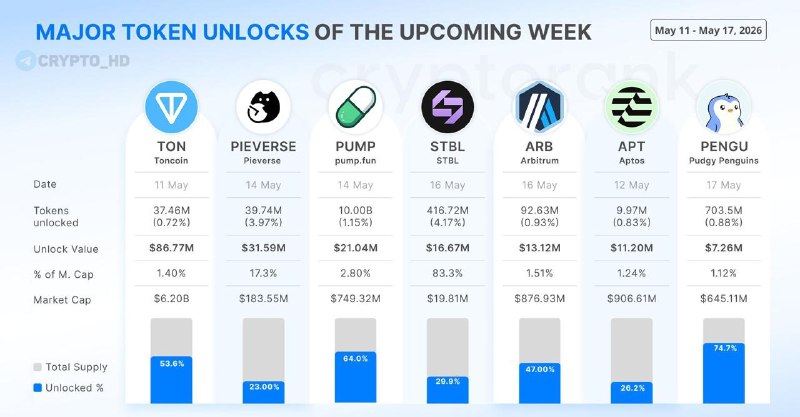
The reported list runs from 11 May through 17 May and includes seven unlocks: $86,77m, $31,59m, $21,04m, $16,67m, $13,12m, $11,2m, and $7,26m. According to the source post, that is all the confirmed detail available. My take: the $86,77m unlock is where traders will look first, not because every large unlock sells off, but because size changes behavior. Most guides say unlocks are bearish. That is only half right. They are bearish when liquidity is too thin to absorb sellers without repricing.
For BTC and ETH, this is more about market structure than fundamentals. I’ll be honest: I care less about the headline unlock number than about what traders do before it hits. When large unlocks appear on weekly calendars, smaller altcoin exposure often gets cut first. If liquidity slips, some capital moves into BTC or stablecoins. Why does this matter? Because BTC can look firm while the rest of crypto is quietly de-risking. Unlock pressure starts with affected assets, but it can spread fast when leverage is already high.
The macro setup matters too. Supply events hit harder when liquidity is shaky before the event begins. In risk asset markets, scheduled supply can weigh more when traders expect tighter liquidity, higher real rates, or weak spot demand. BTC and ETH do not need to be on the unlock list to feel the spillover. Counter to the usual advice, watching only the unlocked token can miss the actual hedge trade. If altcoin books handle the $86,77m entry badly between 11 May and 17 May, derivatives traders may hedge with BTC or ETH shorts instead of selling only the unlocked names.
BTC can still catch defensive flows inside crypto, but token unlocks are not the same as geopolitical shocks or banking stress. Different situation. BTC sometimes trades like digital gold when markets panic, but an unlock is a supply event, not a systemic financial shock. In practice, the $31,59m, $21,04m, and $16,67m entries matter as a cluster because traders may treat them as one liquidity window, not three neat isolated events. If capital leaves smaller tokens, BTC may benefit from crypto native rotation while still trading like a risk asset against the dollar.
The source post does not provide token names, market reactions, protocol details, vesting categories, exchange data, recipient data, or circulating supply percentages. That limits the call. Yes, this makes the conclusion narrower than the headline wants it to be, but that is the point. The May 2026 token unlock schedule points to possible sell side liquidity, but it does not prove selling will happen. Unlocks give holders the option to sell. They do not force everyone to dump on 11 May.
What this means
Supply calendars still matter for crypto traders. They are not background noise. I’d watch altcoin liquidity first, then BTC dominance. Seven unlocks between 11 May and 17 May, led by $86,77m, can shift positioning before tokens even move on chain. Is this overkill for one weekly calendar? No, because crypto often reprices before the mechanical supply event. For BTC and ETH, the effect is indirect but real because traders use the two majors as hedges and collateral. They also use them as exit routes when smaller markets get crowded.
Traders should watch 17 May as the end of this unlock window, then compare spot volumes, funding rates, and BTC dominance with the unlock schedule. We’ve seen this pattern before: the unlock is public, the positioning move comes early, and the post-event reaction depends on whether spot demand was strong enough. Exact levels depend on live market conditions. The practical trigger is simple: if the $86,77m unlock lands while open interest is rising and spot demand is weak, volatility risk rises in the unlocked names. Rotation into BTC, ETH, or stablecoins then becomes more likely.