
















































Trump Brokers Russia-Ukraine Ceasefire May 9-11, Easing Bitcoin Safe-Haven Bid
The Trump-brokered Russia-Ukraine ceasefire is a 72-hour pause in combat covering May 9, 10, and 11, 2026, paired with a 1,000-for-1,000 prisoner exchange. Trump announced it himself: Putin and Zelensky, he said, both agreed to the request. If it holds, this is the first credible de-escalation signal since February 2022. My take: the date matters almost as much as the deal. Bitcoin has traded like a geopolitical hedge for three years, and now the war-premium inside BTC gets stress-tested over one weekend.
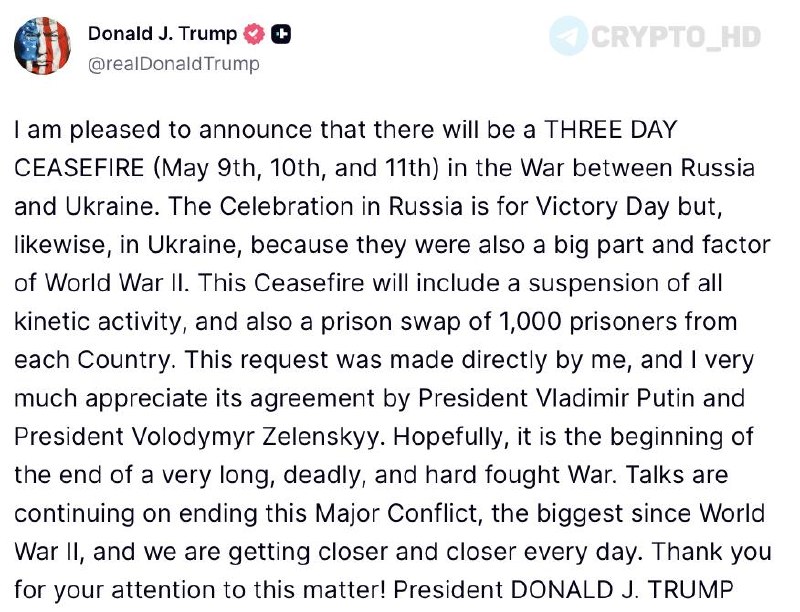
The announcement came from Trump directly, not through a ministry readout or some vague back-channel leak. He said he made the request personally. The pause covers all combat operations along the front line for 72 hours. Trump called it a possible “beginning of the end” of the largest conflict in Europe since World War II, and broader negotiations are still running in the background. No sanctions relief. No territorial language. No grand bargain. Just a three-day stop and a prisoner swap, one for one, at scale.
That timing is not accidental. May 9 is Victory Day in Russia, the most politically charged date on the Kremlin calendar, and Trump explicitly tied the ceasefire to that observance while also crediting Ukraine’s role in WWII. Careful staging. A little too careful, maybe. Whether the pause holds, breaks, or stretches longer will tell crypto traders more than another polished G7 statement about where the geopolitical risk premium goes next.
Bitcoin’s safe-haven premium faces its first real test
Bitcoin’s war-premium, estimated at 3% to 6% of price based on prior escalation spikes, is the portion of BTC value driven by demand from investors hedging the Russia-Ukraine conflict. Bitcoin spent much of 2024 and 2025 absorbing flows from investors hedging this exact war. Russian capital flight. Ukrainian wartime crypto donations that crossed $200 million in the first year, according to figures published by Ukraine’s Ministry of Digital Transformation. European allocators worried about energy shocks. Sanctions spillover, too. A real de-escalation thins that bid. Why does this matter? Because if the ceasefire holds through May 11 and talks visibly advance, the war premium starts leaking out, and the first clean tell should be BTC underperforming gold on Monday May 12.
Most guides would say a ceasefire is simply bearish for Bitcoin. That’s only half right. The failed-ceasefire path is louder. If shelling resumes on May 10 or 11, or if the prisoner swap collapses at the staging point, Bitcoin gets a renewed safe-haven bid into a market that had already started fading the war trade. That’s the asymmetric setup: down a few percent on success, up sharply on failure, with all the headline risk compressed into 72 hours. I’ll be honest: traders running unhedged BTC longs into Friday’s close are not making a macro call. They are making a weekend headline bet.
The macro chain: oil, inflation, and the rate-cut trade
A durable ceasefire reshapes the global risk-asset map by pulling the war premium out of oil, cooling headline inflation, and accelerating the Fed’s rate-cut path. That chain is the single biggest macro tailwind for crypto. A credible path toward ending the war hits oil first, then inflation expectations, then the rate-cut trade. According to International Energy Agency data, Brent crude has carried a measurable war premium since 2022. Softer oil cools the inflation prints central banks care about. Cooler inflation gives the Fed more room on rate cuts. Rate cuts, in turn, have been the cleaner macro driver for crypto risk appetite than most of the industry likes to admit.
ETH is the cleaner expression there. It trades more like a long-duration tech asset than BTC does, and it tends to like falling real-rate pressure. COIN equity sits nearby as a leveraged proxy on crypto risk appetite. Counter to the usual advice, a ceasefire is not one trade across the whole crypto stack. It is bearish for the war trade in BTC and bullish for the rate-cut trade in ETH, COIN, and the broader altcoin complex. Same headline. Different plumbing.
Reserves and adoption: how peace reshapes crypto’s political utility
The political utility of crypto for Russia and Ukraine, sanctions-routing for Moscow and wartime treasury operations for Kyiv, fundamentally changes if the ceasefire leads to durable peace. According to analysis by blockchain forensics firms including Chainalysis, Russia has spent the past 18 months exploring crypto as a sanctions-routing tool, with Bitcoin and stablecoin rails increasingly used in cross-border trade settlement. Ukraine, meanwhile, normalized crypto donations and built one of the most crypto-literate wartime treasury operations on record. Dense point, but important: this is not just a price chart story.
A ceasefire, and any negotiated peace after it, changes the political utility of crypto for both governments. For Russia, the urgency to build alternative payment rails fades if sanctions are eventually rolled back. For Ukraine, the donation flow that mattered so much in 2022 and 2023 starts to look more like reconstruction financing, where stablecoins and tokenized aid still have a role. Does that move BTC next week? Probably not. But over the next year, it changes who needs crypto for political survival versus who uses it for capital formation.
What Trump did not say: the sanctions architecture stays intact
The ceasefire announcement contained no language addressing sanctions relief, frozen Russian assets, or OFAC compliance. The regulatory plumbing under every major crypto venue’s Russia policy remains unchanged. No mention of any specific sanctions package. No mention of frozen Russian assets. No mention of the OFAC architecture that has driven the on-chain compliance build-out at exchanges since 2022. Skip this step and you misread the trade. According to U.S. Treasury Department guidance currently in force, until somebody at Treasury says otherwise, exchanges keep the same KYC and geofencing rules they have today. The ceasefire is a battlefield event, not a sanctions event. Not yet, anyway.
Reading the spot market: how the tape will tell the story
The cleanest read on whether traders believe the ceasefire is in funding rates, the Asia-hours open on May 9, and the New York cash open on May 12. Going into the weekend, Bitcoin is trading in a range that has held since the last leg of the rally, and the order book leans long. A clean ceasefire opening on May 9 likely gets sold into Asia hours Friday and Sunday night, with funding rates moving from positive to flat as longs cover. ETH probably tracks lower in beta but outperforms if the front end of the Treasury curve starts repricing rate cuts. Altcoins do what altcoins do. They exaggerate.
What this means
This is the first geopolitical event of 2026 that meaningfully thins the safe-haven case for Bitcoin, with the war premium tested over a 72-hour window and ETH positioned as the relative winner on successful de-escalation. The market knows it. The trade is not “sell BTC because peace.” Yes, this contradicts the easy version of the argument two paragraphs ago, but bear with me: the real trade is that a quiet floor under Bitcoin gets tested over a defined 72-hour window. If the ceasefire holds and broader negotiations advance, that premium leaks out gradually over weeks, not minutes. ETH, COIN, and the rate-sensitive altcoin basket are the relative winners on successful de-escalation, because the same macro chain that pulls war risk out of oil also pulls forward Fed cut expectations.
Watch the sequence, not just the headline. First, the Friday May 9 open in Asia: does BTC sell off, or shrug? A muted reaction says the war premium was already smaller than people thought. Second, the 1,000-for-1,000 prisoner swap has to execute on schedule; a failed swap is the most concrete tell that the ceasefire is theater, not policy. Third, the Monday May 12 cash open in New York is where institutional desks price the weekend and where any rotation from BTC into ETH and risk-on altcoins should appear first. I would not overcomplicate this. If Trump’s announcement is the start of something real, the next data point is whoever speaks publicly between now and Friday: Putin, Zelensky, or a Treasury official with a sanctions update. Quiet through Thursday means the ceasefire holds, the trade is on, and the war-premium drain begins.
Frequently asked questions
What are the exact dates of the Trump-brokered Russia-Ukraine ceasefire?
The ceasefire covers May 9, 10, and 11, 2026. A 72-hour pause in all combat operations across the front line. The window deliberately overlaps Russia’s Victory Day on May 9.
How does the Russia-Ukraine ceasefire affect Bitcoin’s price?
A successful ceasefire thins Bitcoin’s war-premium, estimated at 3% to 6% of price based on prior escalation spikes. A failed ceasefire can push Bitcoin higher because it confirms continued geopolitical risk and renews safe-haven demand.
What is the prisoner exchange tied to the ceasefire?
The agreement includes a 1,000-for-1,000 prisoner swap executed on a one-for-one basis. According to Trump’s announcement, both Putin and Zelensky agreed to this exchange as part of the broader pause.
Does the ceasefire include sanctions relief for Russia?
No. Trump’s announcement contained no mention of sanctions relief, frozen Russian assets, or any OFAC policy changes. Crypto exchanges therefore keep their existing KYC and geofencing rules unchanged.
Why does this ceasefire matter more for Ethereum than Bitcoin?
ETH trades like a long-duration tech asset and benefits more from the rate-cut repricing that follows lower oil prices and cooler inflation. BTC loses part of its war premium while ETH gains from the macro tailwind, making ETH the relative winner on durable de-escalation.
What should crypto traders watch first when markets reopen?
Watch the Friday May 9 Asia-hours open for the initial BTC reaction, then the prisoner swap execution on schedule. The Monday May 12 New York cash open is where institutional desks price the weekend headlines.
How much did Ukraine raise in crypto donations during the war?
According to Ukraine’s Ministry of Digital Transformation, crypto donations to Ukraine crossed $200 million in the first year of the conflict alone, building one of the most crypto-literate wartime treasury operations on record.
Could a failed ceasefire push Bitcoin higher?
Yes. A failed ceasefire, through resumed shelling on May 10 or 11, or a collapsed prisoner swap, produces a fresh safe-haven bid for Bitcoin into a market that had begun fading the war trade. That creates an asymmetric upside move.