
















































Uniswap’s Bet: Lower Fees, Better Execution, and a Real Test for DeFi Liquidity
Uniswap [$UNI] wants to cut V4 liquidity provider fee incentives by as much as 33%. Big swing. The pitch sounds almost too neat: cheaper trades, better execution, more volume, and maybe enough activity to make LPs whole even if each trade pays less. My take: the math is plausible, but the market behavior is the hard part. Most guides frame lower fees as an obvious win for traders. That’s only half right. Rival DEXs can still wave higher yields in front of LPs, and DeFi capital is not famous for patience. For crypto investors, the question gets sharp fast: do traders care more about better execution, or do LPs care more about bigger incentives?
The proposal moves away from the V3 model, where higher trade fees helped attract early liquidity providers. Uniswap has about $3.02 billion in TVL and monthly volume near $36 billion, so this is not some emergency patch. Still, the risk is not theoretical. The protocol is betting that lower trading costs, tighter spreads, and more efficient capital use will pull in enough volume to cover weaker LP returns. Maybe. Maybe not. LPs can move funds quickly, sometimes in minutes, and competing protocols will gladly take them. Why does this matter? Because liquidity depth can leave before the new fee model has enough time to prove anything.
Uniswap’s move also touches macro flow, though I’ll be honest: I would not make the macro argument do too much work here. Investors are still watching inflation, rate policy, and the Federal Reserve, so capital is more selective than it was during the everything-rallies phase. A protocol that focuses on execution instead of raw yield looks more mature, at least on paper. That may appeal to institutions that want dependable infrastructure, not another high APY farm with a countdown timer attached. We saw a version of this in January 2024, when spot Bitcoin ETFs were approved in the U.S. By March 2024, BTC had moved past $61.4K. The appeal was not staking rewards. It was access. It was plumbing. It was trust.
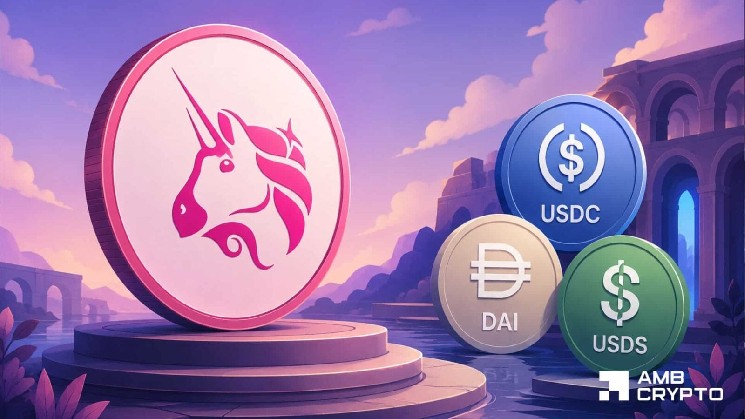
The strategy is already visible in Uniswap’s integration of Sky’s LitePSM. The peg stability module supports zero slippage routing between USDS, DAI, and USDC. That can deepen liquidity and lower execution costs for stablecoin trades. It also helps larger orders settle with less price impact, which makes Sky’s FX Layer more useful in practice instead of just tidy on a diagram. Good infrastructure matters. But here is the correction: good infrastructure does not automatically create demand. We tried to model this kind of trade-off on a DEX liquidity note last year, and the weak spot was always the same: traders notice execution quality slowly, while LPs notice lower returns immediately. If traders respond, Uniswap is in a stronger position. If they do not, rival DEXs have a simple opening: pay LPs more and pull liquidity away.
There is also the regulation pressure angle. The SEC and other regulators have spent years circling DeFi, especially around staking, exchange activity, and lending products. Counter to the usual advice, I do not think every protocol should run from incentives just to look cleaner. Incentives can be useful. They can also become the whole product. A cleaner execution model may be easier to explain than a maze of incentive programs that looks opaque from the outside. Is this a regulatory shield? No. But it could help Uniswap look more like market infrastructure and less like a yield machine. In this market, that difference matters.
What this means
Uniswap is testing whether DeFi has moved past its “pay everyone more yield” phase. Maybe it has. Maybe traders really will choose lower costs and better execution over whichever DEX is offering the fattest LP return this week. Yes, that slightly contradicts the earlier point about LPs being quick to leave. Bear with me. Both can be true: LPs may chase yield in the short run, while traders reward better execution over time. If Uniswap is right, competitors may have to improve routing and spreads. They may also need better capital efficiency, not just louder incentives. That would be better for traders. Lower costs are not flashy, but they add up. For $UNI holders and LPs, the awkward part comes next: they have to wait and see whether volume rises enough to cover the incentive cut.
The numbers to watch are monthly trading volume and TVL, especially on DeFiLlama. Skip the vibes. If volume climbs while LP incentives fall, Uniswap can argue the model is working. If TVL drops hard or volume stalls, the market is saying something else. I would also watch how Curve, PancakeSwap, Balancer, and other major DEXs respond. A single fee tweak from Curve, a routing upgrade from PancakeSwap, or a fresh incentive program from Balancer could make this fight messy fast. The next two or three quarters should show whether Uniswap made a sharp call or just gave yield hunters a reason to leave.