















































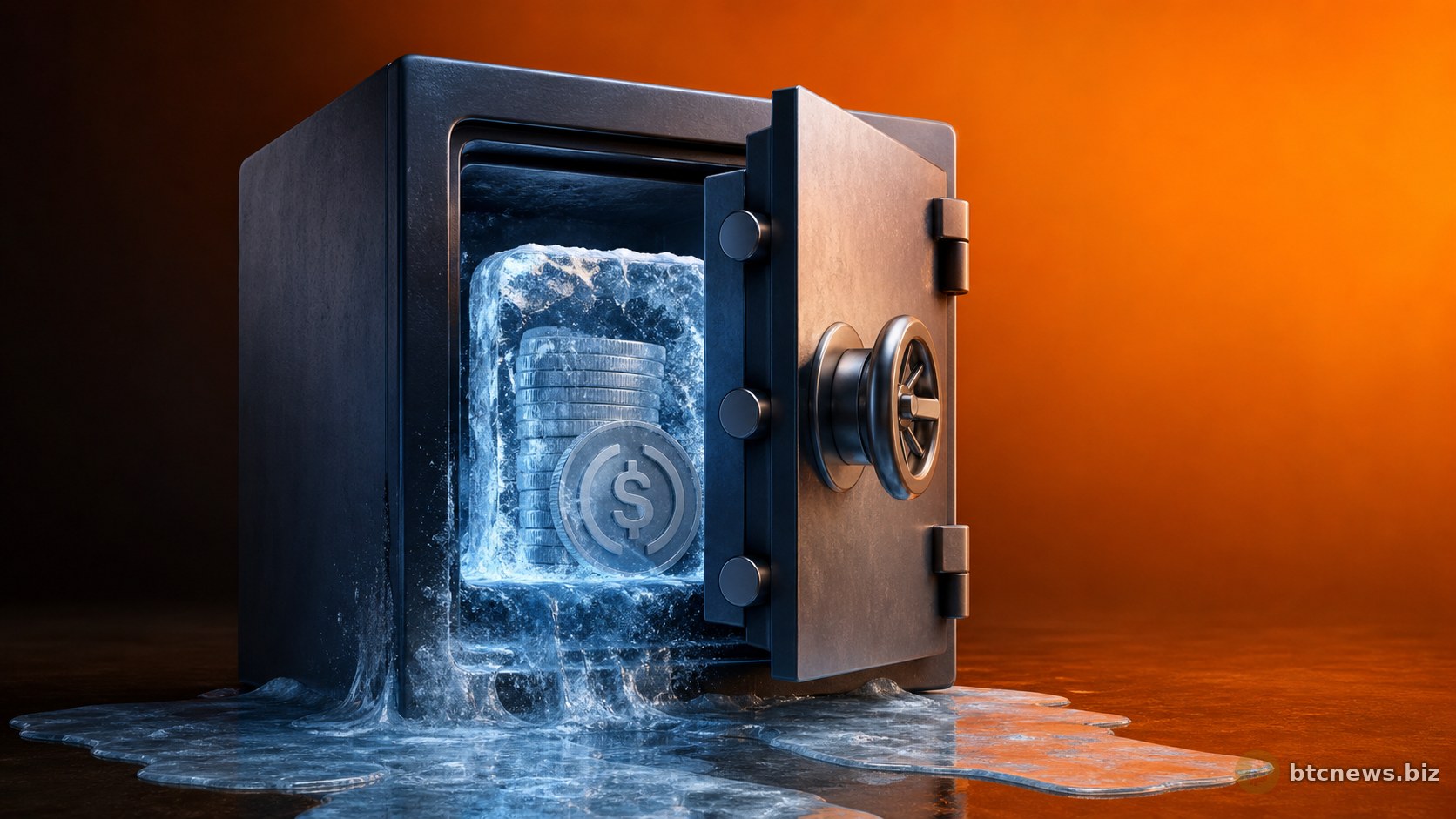
Your Stablecoins Could Be Frozen Without Warning, Even If You Did Nothing Wrong
Your stablecoins could be frozen without warning, even if you did nothing wrong. Sounds dramatic. It is not, once you look at how freezes actually happen. This week, Jan Philipp Fritsche, co-founder of Bermuda, a privacy compliance tool for Ethereum, pointed to a real flaw: clean funds can get trapped when stablecoin issuers use blunt enforcement tools or compliance shortcuts that are too crude for live markets. In a market with about $150 billion in stablecoins outstanding, that is not some tiny corner case. My take: this cuts straight into the basic promise of stablecoins, which is dollar-like money that works on crypto rails without turning every transfer into a support-ticket gamble.

Fritsche told Bitcoin.com News that the goal is not always the issue. Issuers and banks may be trying to block stolen or sanctioned funds. Fair enough. The problem is the method. Freezes can sweep too widely, and the systems behind them may fail to separate one bad wallet from everyone who happened to touch nearby activity. A user with no accusation against them can wake up and find their money locked anyway. “Often, legitimate funds are only frozen by accident,” Fritsche said. “Stablecoin issuers and institutions sometimes need to freeze specific illicit funds in response to court orders; however, they often lack the capabilities to do so tactically and end up freezing legitimate funds as collateral damage.”
Compliance software can also be jumpy. Fritsche said some institutions lean on “flawed heuristics” that treat unusual activity as suspicious even when it is legal. That leaves two very different groups exposed: beginners clicking around awkwardly. Experienced traders doing something the model has not seen much before. “The two groups most at risk of having funds frozen in this way are novice crypto traders, and seasoned trading veterans, heuristics-wise, they are often the outliers,” Fritsche said. “A beginner performing random actions or a veteran trader leveraging a novel trading strategy can both appear unusual, and trigger precautionary enforcement actions.” Most guides frame this as a beginner-risk problem. That is only half right. The weird part is that the least sophisticated user and the most sophisticated user can both look suspicious for opposite reasons.
Here is the ugly part: users may get no warning. None. Why does this matter? Because a freeze without notice turns a payment asset into something closer to a locked account with no front desk. In some cases, the issuer may not be allowed to contact the user before the freeze happens. Fritsche said, “In fact, the issuer is not allowed to warn or communicate with the to-be-frozen user. Even after the fact, the user can only go through the court, which is a very tedious process.” For a normal customer, that is a mess. Your money is locked, nobody says much, and the answer is basically: go to court. I’ll be honest: I do not see how that fits neatly with the pitch for open finance. It also gives regulators an easy argument. If stablecoins can freeze innocent users by mistake, officials already worried about systemic risk may push harder for tighter rules, or for CBDCs as the cleaner option.
The reputational damage could be real. Fritsche put it plainly: “The most obvious is reputational harm for the industry.” He also compared the experience with traditional finance: “Users rarely have their funds frozen using traditional finance. They will see stablecoins and other crypto rails as a step backwards if they deliver a decidedly worse user experience.” That comparison matters because stablecoins are supposed to connect banks and crypto. If that connection feels unreliable, institutional users may slow down. Liquidity could shift. DeFi would feel it too, since stablecoin pairs and stablecoin collateral support a large share of on-chain trading. ETH, for example, leans heavily on stablecoin liquidity across exchanges and lending markets. Counter to the usual advice, this is not just a legal-risk footnote. It is market structure risk.
What this means
This is a direct clash between compliance and user control. Centralized stablecoins such as Circle’s USDC and Tether’s USDT can be frozen, which is one reason regulators tolerate them. But that same power becomes a problem when enforcement hits the wrong person. Yes, this sounds like a contradiction: the feature that makes USDC and USDT more acceptable to regulators can also make them less attractive to users. If mistaken freezes become more visible, some users may move into decentralized alternatives, while others may go back to fiat. The first signs would probably show up in stablecoin trading volume and market cap changes. Then watch the small but stubborn wobbles around the $1 peg.
Investors should watch what Circle, Tether, and other major issuers do next. Better freeze targeting would help. Clearer appeals would help too. Faster dispute handling matters more than a polished policy page. Silence would not. Is this overkill? For a market with about $150 billion in stablecoins outstanding, no. More reported freezes could add pressure from the SEC, Treasury, and other regulators already looking at stablecoin oversight. Peg behavior matters too. A stablecoin trading at a discount for more than a brief moment can point to stress underneath. Privacy compliance tools are also worth watching, because they may be one of the few ways to meet legal demands without treating every weird transaction like a crime scene.
FAQ: Stablecoin freezing risks
What is the primary risk highlighted regarding stablecoins?
The main risk is simple: legitimate stablecoin funds can be frozen without warning because an issuer’s enforcement tools or compliance systems get it wrong, even when the user has done nothing illegal. That is the whole problem in one line.
Who is most at risk of having their stablecoins frozen?
Jan Philipp Fritsche said novice crypto traders and experienced trading veterans are most exposed. Beginners may behave randomly. Advanced traders may use strategies that look unusual to compliance systems.
Why do stablecoin issuers freeze funds?
Issuers may freeze funds because of court orders aimed at illicit assets. Fritsche’s concern is more specific: they often lack precise tools, so legitimate funds can get frozen as “collateral damage.”
Will users receive a warning before their stablecoins are frozen?
No. Users should not expect advance warning. Fritsche said issuers may be legally barred from contacting the affected user before the freeze, and sometimes even after it.
What are the potential consequences for the stablecoin industry due to these freezing risks?
The industry could lose trust. If users see stablecoins as unreliable or prone to mistaken freezes, institutional adoption may slow and some capital may leave the sector. My read: trust will not vanish all at once. It usually leaks out case by case.
How does this issue compare to traditional finance?
Fritsche said users rarely have funds frozen in traditional finance. If stablecoins are worse on this point, many users will see them as a step backward. That stings, because stablecoins are usually sold as the upgrade.
What impact could this have on the broader crypto market?
The issue could bring more regulatory scrutiny, strengthen arguments for CBDCs, and affect stablecoin liquidity. That would matter for major assets such as ETH, which rely on stablecoin pairs across trading and DeFi markets.
What should investors monitor regarding this issue?
Investors should monitor issuer responses from Circle, Tether, and other stablecoin operators. They should also watch regulator statements, stablecoin peg deviations, reported freeze cases, and privacy compliance tools that claim to reduce false positives.
What is a “flawed heuristic” in the context of stablecoin compliance?
A “flawed heuristic” is a rule or algorithm that flags legal but unusual activity as suspicious. In this context, it can cause innocent users to be treated as high risk. Small rule, big mess.
Could this lead to a shift away from centralized stablecoins?
Yes. If mistaken freezes become common or high profile, users may move away from centralized stablecoins such as USDC and USDT toward decentralized options or fiat. Counterintuitive, but possible: tighter controls could make regulated stablecoins look less like cash and more like bank accounts with crypto branding.