
















































TON Core Launches Acton to Bring AI Agents and Smart Contracts to TON Blockchain
Acton is a new developer toolkit from TON Core for building AI agents and smart contracts on the TON blockchain. TON Core just shipped Acton, and the timing is not accidental. Every major Layer-1 wants to be the default home for on-chain AI right now. TON has Telegram’s 900M+ user base behind it, so it cannot afford to let Solana, Base, or Near define the whole category first. My take: this is positioning before it is product proof.
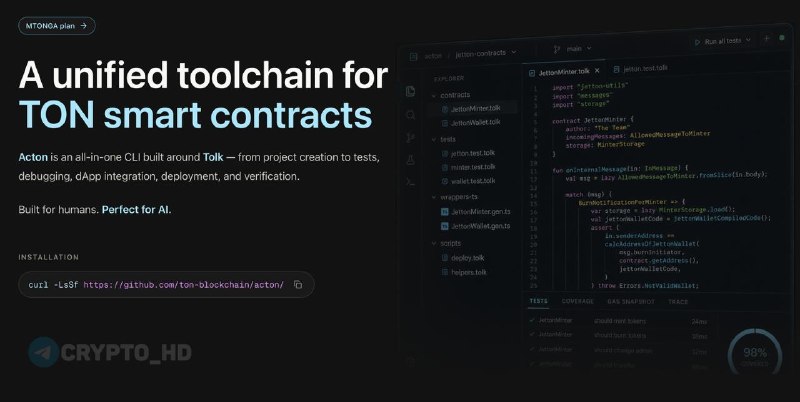
The announcement lands after a solid stretch for TON. Recent network updates put the chain near the top on activity metrics, alongside the mini-battle campaign, the fee cut, and the repeated transaction-speed push. Acton rides that setup. The point is simple: turn a fast, cheap chain into somewhere autonomous agents can move value without making users bleed gas. That part matters.
AI-agent tokens have been one of the few corners holding a bid through the spring 2026 chop. ai16z, Virtuals, and Fetch.ai have pulled in capital that might otherwise have sat in majors. TON barely touched that flow. I’ll be honest: for a chain with Telegram distribution, its AI footprint looked weirdly empty. No agent framework. No native tooling. No obvious builder path for the category. Acton is the patch.
Adoption signal, and this is the heavier of the two angles. TON’s pitch has always been distribution. Build something, plug it into a Telegram mini-app, and you are one tap from hundreds of millions of users. Why does this matter? Because an agent that can swap, stake, or settle a payment inside a Telegram chat avoids the ugliest part of crypto UX: making the user leave the surface they already understand. Solana and Base still struggle there because their distribution usually starts in browser extensions, not chat threads. Counter to the usual advice, the best agent chain may not be the chain with the loudest dev culture. It may be the one with the least friction at the point of use.
AI-agent narratives have correlated tightly with risk-on rotations, and TON has been a high-beta proxy for that thesis. The token’s last leadership stretch lined up with capital rotating out of pure-meme exposure and into infrastructure plays with a utility story traders could repeat without wincing. Acton gives them something more concrete to underwrite. A tooling layer, not a slogan. That distinction is small on launch day and large 90 days later.
The fee cut and speed push start to look like a coordinated setup in hindsight. Most guides would say low fees are just table stakes. That’s only half right. AI agents create a brutal load profile: high-frequency, low-value, latency-sensitive transactions that may run in loops. A chain pricing those at Ethereum mainnet levels is dead on arrival for this use case. TON spent the last quarter pre-paying the infrastructure tax with lower fees and faster blocks, so Acton can launch into conditions that might actually survive agent traffic.
The launch ships without a token, points program, or airdrop signal. That is either discipline or a missed marketing window. I lean toward discipline, but only slightly. The agent-token complex on Solana minted billions in market cap on thinner premises, so TON could have chosen the easy hype route here. It did not. Yes, this contradicts the “positioning first” read above. Bear with me: the announcement can be narrative-driven while the product strategy stays unusually restrained.
What this means
Acton’s fate hinges on developer adoption inside the next 60 to 90 days. TON has a distribution layer no other chain can match. It also has a builder base that usually defaults to mini-apps and games, not infrastructure-heavy autonomous agents. Is this overkill? For a 50-page whitepaper, maybe. For a chain trying to enter the AI-agent trade, no. If Acton pulls in even three or four named agent projects, the narrative compounds quickly and TON’s price can re-rate against AI-agent peers. If the framework launches and goes quiet, it becomes another TON tooling announcement without a flagship app. Watch GitHub commit velocity. Watch the first Acton-built mini-apps inside Telegram.
For traders, the binary resolves on shipping, not on the press release. The levels that matter are TON’s prior leadership-cycle highs and the AI-agent sector benchmark. A meaningful breakout in TON, paired with Acton developer traction, would mark the chain’s entry into a category it has been locked out of since late 2024. The downside is cleaner and colder: no developer pickup, no flagship agent, and TON goes back to being judged on mini-app DAUs and fee metrics. My read is blunt here. Ship usage, or the market forgets. Next checkpoints: any Acton-built agent going live in a Telegram mini-app, plus whether TON Core publishes traction numbers within the quarter, including active developers, deployed contracts, and agent transaction counts.