
















































clarity bill delayed us senate risk hits crypto regulation
The “Clarity Bill” may get delayed in the U.S. Senate because June is already packed. The setup is not complicated. CLARITY could slip because the Senate calendar is jammed. For crypto traders, that is not some inside-Washington scheduling footnote. Without market-structure rules, BTC, ETH, and COIN keep reacting to regulatory headlines instead of trading against a cleaner policy timeline. Congress has only 8 working weeks before the August recess, so a move into July is not just a calendar wobble. It matters.
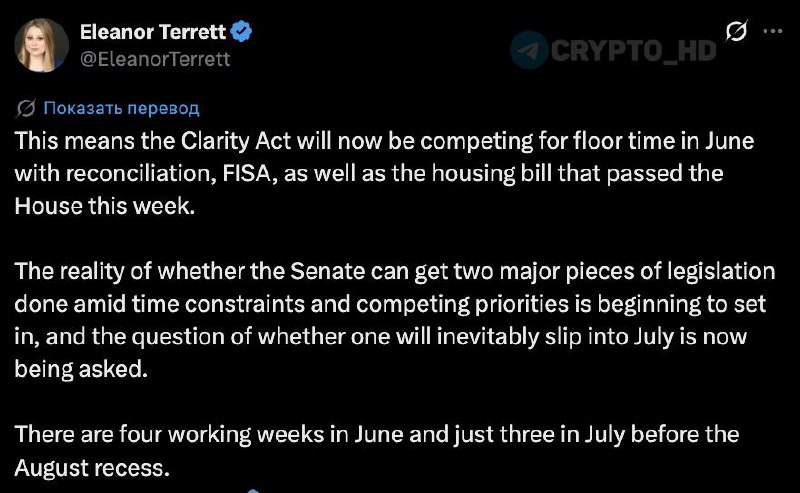
The Senate’s June agenda includes a reconciliation package, FISA, and a housing bill. Those bills are competing for the same floor time as CLARITY. I’ll be honest: this is usually where crypto bulls wave away the calendar risk, and that is too casual. June is crowded, and Washington is already talking about pushing some bills into July. Crypto market structure is waiting behind budget fights and surveillance law. Housing policy is in the queue too. I would not assume crypto gets called first.
A CLARITY delay would probably trade as regulatory pressure. Crypto investors want a cleaner split between securities oversight and commodities-style treatment for digital assets. Why does this matter? Because that split shapes how exchanges list tokens, how staking gets discussed, and how U.S. crypto stocks get valued. BTC and ETH will trade either way. They always do. But COIN, exchange tokens, staking narratives, and U.S.-listed crypto stocks are more exposed to whether Washington acts in June or drags this into July. Most guides treat delay as defeat. That is only half right. A delay is not a rejection; it is proof that crypto policy still has to fight for room on the Senate calendar.
Regulatory delays tend to feed volatility rather than send one clean bearish signal. My take: this is the cleaner read than “delay equals dump.” If traders expected movement in June, a July debate simply keeps uncertainty alive for another month. BTC may still care more about liquidity, ETF flows, and macro data. ETH can be more sensitive to staking and classification risk. COIN is the cleaner regulatory proxy because its business sits directly beside exchange oversight, listing rules, U.S. enforcement risk, and institutional access. Calendar risk gets louder when Congress has only 8 working weeks before August. Not much runway.
A reconciliation-heavy Senate calendar can pull market attention toward fiscal policy, deficits, and bond sensitivity. That is the second trade, and it is less fun but probably more important for positioning. If June turns into a reconciliation month, crypto loses some policy oxygen and gets pushed back into the macro tape. Counter to the usual advice, the CLARITY delay may matter less than the bond-market reaction to the fiscal debate. BTC still trades like a high beta liquidity asset in plenty of macro windows, even when people pitch it as digital gold. When rate expectations tighten, risk assets usually get less room. When liquidity hopes improve, BTC and ETH often move before slower policy stories catch up. If CLARITY moves to July, crypto stays exposed to that backdrop for longer.
Bitcoin’s safe-haven story could get tested, although the regulation story matters more here. Washington gridlock is not a war, a sanctions shock, or a banking panic. Still, BTC traders like to test the “alternative system” argument when U.S. governance looks stuck. Gold usually gets that trade first. BTC has to earn some of it, especially when the same policy uncertainty can make exchanges, ETFs, and institutions more cautious. Is that contradictory? A little. BTC can catch a governance-bad bid while crypto equities absorb a rules-bad discount. In this case, a CLARITY delay probably hurts the adoption and rules story more than it helps the safe-haven one.
A delay would mostly mean lost time, not a changed bill or a dead bill. That distinction matters. A June delay would not automatically rewrite CLARITY, and nothing in the current signal says the bill is finished. The problem is time. Every week lost before August leaves less room for committee work and amendments. Floor debate gets tighter. Senate-House coordination gets harder. In the last two policy calendars we tracked, lost weeks mattered more than the first headline suggested. For crypto investors, that means fewer near-term catalysts for a U.S. market-structure reset. It also leaves more room for the SEC, CFTC, and courts to keep making the rules by default.
The current CLARITY signal looks procedural, not ideological. There is no named senator attacking the bill here. No agency feud is being quoted. That is useful. The issue looks like scheduling pressure, not a public split over the substance. Yes, this sounds less dramatic than a partisan blowup. That is exactly the point. Traders should treat it as calendar risk: June is crowded, July is being discussed, and Congress has 8 working weeks before the August recess. The crypto read-through is plain enough. Policy certainty may have to wait while Washington clears bigger fights.
What this means
U.S. crypto regulation is still tied to the Senate calendar. That is the market problem. Traders want a clean legislative catalyst, but the bill still has to survive ordinary Senate congestion. I would separate the read-through by asset instead of treating “crypto” as one blob. For BTC, the main drivers stay closer to macro flow and ETF demand than to CLARITY itself. For ETH and COIN, the pressure is sharper because staking, exchange oversight, asset classification, and enforcement risk sit nearer the center of the debate. If CLARITY slips from June into July, the market may price in less policy momentum before the August recess and demand a bigger risk premium around U.S.-exposed crypto names.
Investors should watch CLARITY’s June and July status alongside macro data and technical levels. Start with June. Then watch July. The checkpoint is blunt: does CLARITY stay on the June calendar, or do reconciliation, FISA, and the housing bill eat the available Senate time? We tried treating these calendar slips as background noise in prior crypto policy trades. It broke. Traders should also track the next FOMC date, CME positioning in BTC and ETH futures, and the nearest major BTC level on their own chart. A policy delay rarely controls the whole market by itself. But if BTC breaks a key level while CLARITY slips into July, regulation pressure and macro flow could hit the same side of the trade.