
















































Turkey Money Laundering Bust: Grand Bazaar Crypto Link Puts Regulators on Alert
Turkish authorities have charged 504 people with laundering nearly $850,000,000. That number is hard to shrug off. The alleged routes are messy too: the Grand Bazaar, POS terminals, shell companies, and cryptocurrency. My take: the crypto part is the piece most likely to travel beyond Turkey’s borders. Fair or not, this is the sort of case regulators cite when they demand tougher checks from exchanges, brokers, wallet services, and payment firms. Bitcoin (BTC) and Ethereum (ETH) are already moving through a market shaped by regulation, lawsuits, ETF flows, and risk appetite. This adds a bad headline at a bad time.
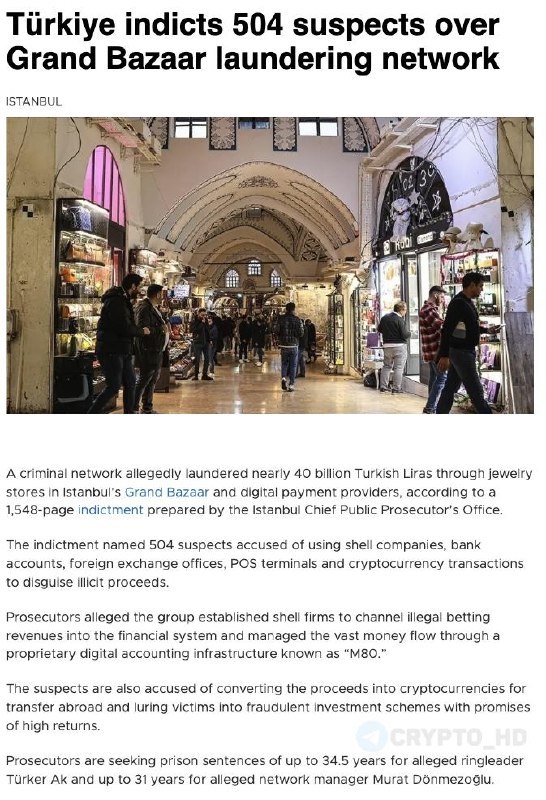
The charges come from an investigation into an alleged laundering network that moved about $850,000,000. Prosecutors say the accused used the Grand Bazaar, point-of-sale (POS) terminals, shell companies, and crypto. The alleged ringleader, Türker Ak, is still at large, and prosecutors are seeking up to 34.5 years in prison. Murat Dönmezoğlu, described as a manager in the operation, has been arrested and faces up to 31 years. Of the 504 suspects, 36 remain at large and 134 have been detained. Start there. This is a Turkish criminal case before it is a crypto story. Still, the crypto angle matters because it lands right in the middle of a fight regulators were already having: digital assets can move money quickly, while police often arrive after the trail has cooled.
Here is the uncomfortable bit. Every time a large laundering case includes crypto, the regulation story gets louder. Most crypto-market commentary treats that as background noise. That is only half right. Regulators do not need much help making the case, especially after FTX collapsed and centralized exchanges faced tougher questions about custody, reserves, transparency, and basic controls. This case pushes the focus toward AML and KYC. I’ll be honest: I would not assume BTC or ETH drop 5% to 10% in a day because of one Turkish prosecution. Markets rarely behave that neatly. The slower effect makes more sense: stricter onboarding, more transaction monitoring, higher compliance costs, fewer gray-area services. If big exchanges have to spend more on compliance, they may slow down in new markets or shelve products that looked viable a month ago. Why does this matter? Because sentiment can flip fast, especially after BTC touched $61.4K in early March.
The case also changes how capital looks at crypto risk. Crypto is often sold as an alternative to the traditional financial system. Then a story like this lands, and that pitch gets harder to make for a while. We have seen this pattern before in regulatory cycles: the technology story gets crowded out by the enforcement story. When the conversation moves from “crypto as new infrastructure” to “crypto as a laundering rail,” some institutions will pause. Not forever. Long enough to matter. Investors have already pulled back from risk assets when Fed policy, inflation, or liquidity conditions looked shaky. A major laundering case with a crypto connection gives them another reason to wait before putting fresh money to work. The price impact may not appear in one candle. It can show up over weeks through quieter inflows, weaker appetite for exchange tokens, or a more cautious tone from funds that sounded bold a few days earlier.
What this means
The Turkish case will likely keep regulators focused on crypto-related laundering. It also gives compliance teams another example to point to when they ask for stricter controls. Counter to the usual advice, the first thing to watch is not always BTC price. The first place to watch is exchanges and payment services operating in countries with weaker oversight. Larger banks and more regulated institutions may cut exposure to those firms, especially if the counterparties cannot explain where funds are coming from. That pullback can reduce liquidity in specific regions. Traders should watch for new guidance or enforcement language from FATF, especially around cross-border transfers. Stablecoin issuers may face more pressure too, since stablecoins are among the easiest crypto rails to understand and move at scale.
Investors should watch AML and KYC policy more closely than usual. New laws, enforcement actions, or public statements from major economies could move the market more than the case itself. The G7 and G20 financial stability reports are worth tracking if they mention Turkey, laundering networks, stablecoins, or exchange supervision. Is this overkill? For a market that can reprice on one sentence from a regulator, no. BTC and ETH can absorb plenty of bad headlines, but higher regulatory costs can still cool short-term enthusiasm. Exchange outflows are another signal to watch. If users start pulling funds from centralized platforms after related enforcement news, sentiment may be turning. The next real marker is any formal response from Turkish authorities, FATF, or another international body. That is when this stops being one prosecution and starts looking like a template.
FAQ: Turkey Money Laundering, Crypto, and the Grand Bazaar
What is the significance of the Turkish money laundering bust?
Turkish authorities say the case involves about $850 million and 504 charged individuals. The crypto link matters because it may strengthen calls for tougher AML and KYC rules.
How was cryptocurrency allegedly used in this money laundering operation?
Prosecutors say crypto was one of several channels used to move funds. The alleged network also used the Grand Bazaar, POS terminals, and shell companies.
What is the alleged role of the Grand Bazaar in this scheme?
Turkish authorities say the Grand Bazaar was one of the traditional money-moving channels in the alleged operation.
Who are the key individuals charged in this case?
Türker Ak, the alleged ringleader, is at large. Murat Dönmezoğlu, described by prosecutors as a manager, has been arrested.
How many individuals have been charged in total?
Turkish authorities have charged 504 people in connection with the alleged money laundering network.
What are the potential implications for the cryptocurrency market?
The case could add pressure for stricter KYC and AML checks across exchanges, payment services, and stablecoin issuers. It may also make institutions more cautious.
Could this bust affect the price of Bitcoin (BTC) or Ethereum (ETH)?
One case does not guarantee a sharp price drop. Still, heavier regulation and weaker investor confidence can weigh on BTC and ETH over time.
What is “de-risking” in the context of this event?
“De-risking” means banks or larger financial firms may reduce exposure to exchanges and service providers in countries with weaker compliance controls.
What should investors monitor going forward?
Investors should watch AML and KYC policy updates, Turkish government statements, FATF guidance, and any enforcement actions tied to exchanges or stablecoin flows.
How does this event relate to the “macro flow” of capital?
The case could make some institutions treat crypto as a riskier bet, at least for now. That may slow new capital flows into the market, even if prices do not react immediately.