
















































ZachXBT Bitget pump and dump allegations put exchange listings under fresh scrutiny
The ZachXBT Bitget pump and dump allegations are an on-chain claim that the LAB token team and Bitget coordinated a manipulative listing on 1 May, when roughly 96 million LAB tokens worth about $63 million were pre-positioned on the exchange before a 600% price spike. The timing is what I keep coming back to. According to on-chain investigator ZachXBT, the 1 May LAB rally on Bitget happened only after wallets tied to the LAB team had already moved those tokens onto the exchange. My take: that ordering matters more than the size of the candle. If you trade low-float listings right now, this is the part to stare at. Centralized venues keep listing thin-supply tokens that pump and collapse inside the same week, then the post-mortem, if it comes at all, lands after retail has already been rinsed.
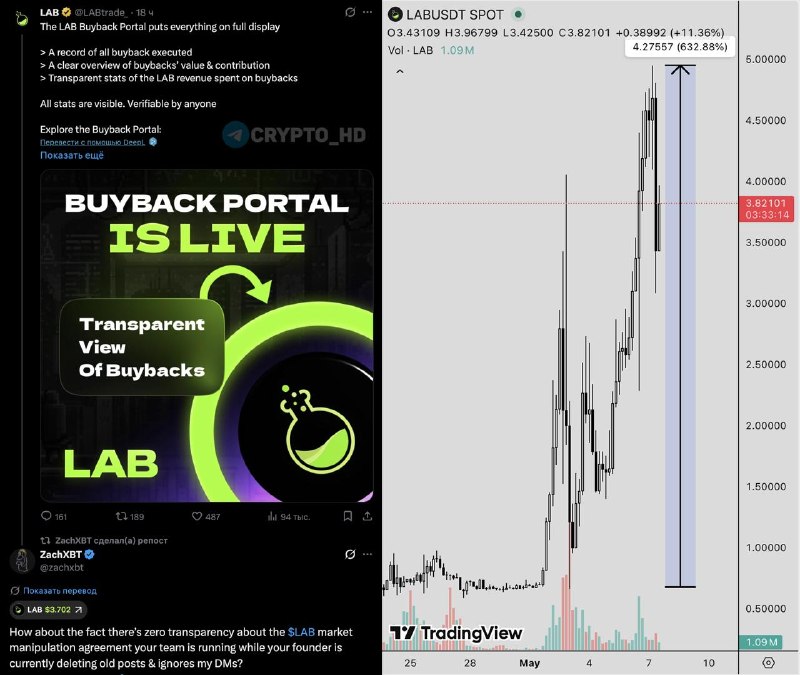
The accusations came from ZachXBT himself, the investigator whose threads have repeatedly forced exchanges into damage control. By his published findings, the wallets in question controlled a meaningful slice of LAB’s circulating supply. They sent the ~96 million LAB to Bitget before the 1 May pump, not after. Why does that matter? Because pre-positioning supply on a venue is what makes a coordinated exit possible at the top of a candle. The candle is late evidence.
There is a second wallet in the story, and that is where the thread really tightens. ZachXBT says a separate address was actively buying LAB on decentralized exchanges and routing those tokens straight to Bitget. The same address, he says, also handled other tokens that ran hard recently, including one that printed +1000% over 30 days. One wallet. Multiple parabolic listings. Same centralized venue. I’ll be blunt: that is not a setup most market makers run by accident.
Bitget’s silence is the other half of the story. ZachXBT says the exchange has yet to publish any results from its earlier investigation into manipulation around RAVE, a token that drew similar accusations. No public report. No clarification. Nobody named. Most exchange crisis guides say the first statement matters most. That is only half right. The missing follow-up is what compounds the damage, especially for an exchange that competes on perpetuals volume and listing speed.
Regulatory implications: why ZachXBT’s findings matter beyond Bitget
The regulatory implication of the LAB allegations is that documented exchange-side coordination on a major venue can shift U.S. and EU enforcement focus from offshore wash-trading cases to listing-side manipulation, with ZachXBT’s on-chain evidence historically appearing in formal filings. U.S. and EU regulators have spent the past 18 months building cases around exchange-side manipulation: wash trading, coordinated listings, insider supply. By prior enforcement filings, ZachXBT’s threads have been load-bearing in those cases. His Lazarus Group work and earlier exchange exposés were cited directly. If the LAB allegations hold up, Bitget does not sit in the softer bucket of “offshore exchange with aggressive listings.” It gets pulled toward the SEC and CFTC radar conversation. That repricing is not only reputational. It bleeds into market-maker willingness to quote, into US-tied institutional flow staying away, and into BTC-quoted volume migrating to cleaner books like Coinbase (COIN), Kraken, and the regulated perpetuals side at CME.
Adoption signal: how pump-and-dump cycles tax the whole market
A pump-and-dump cycle on a major centralized exchange acts as a structural drag on crypto adoption because retail traders who absorb the dump exit the asset class, weakening the follow-through flows that spot Bitcoin ETFs depend on to compound institutional inflows. Every coordinated listing event is a tax on the rest of the market. Retail traders who buy the +600% candle and ride it to zero do not reliably rotate into spot ETH or BTC the next quarter. Some leave the asset class entirely. Is that too dramatic? No, not when the shared chart is a vertical LAB candle followed by a -80% fade. The spot Bitcoin ETF complex still leans on retail follow-through to compound inflows beyond the initial institutional wave, and a rigged-looking Bitget listing makes the “Bitcoin as a maturing asset” pitch harder to sell to a wealth advisor the next morning. Adoption signal is not only about new countries adding BTC to reserves. It is also about not losing the marginal retail buyer to a listing that looks cooked from the start.
The on-chain pattern: a documented pump-and-dump playbook
The on-chain pump-and-dump playbook ZachXBT described is a four-step sequence: a team wallet sends inventory to a centralized exchange, a separate external wallet accumulates the same token on DEX and bridges to that exchange, the listing pumps on coordinated bid pressure, and the team wallet exits into retail demand at the top. The wallet pattern he laid out has the same shape on-chain analysts have been flagging for two years. Counter to the usual advice, the pump is not the thing to chase. It is the warning label. By the time the candle prints +600%, the supply has already been moved. Anyone trading new Bitget listings, or any centralized exchange’s freshly listed low-float token, is now trading against a tape where this exact playbook has been documented twice in roughly a month, counting RAVE.
There is also the cross-token thread. ZachXBT says the same external wallet allegedly working LAB also touched the +1000%/30-day token he referenced. That is the kind of detail enforcement teams underline. A single counterparty across multiple anomalous listings is the difference between “messy market” and “pattern of conduct.” We tried to give that ambiguity room, but the overlap is hard to wave away. It is also the kind of finding that has, in past cases, pushed exchanges to delist quietly, freeze withdrawals on flagged addresses, or, when pressure gets heavy enough, issue the kind of statement Bitget has so far declined to issue on RAVE.
None of this is a verdict. ZachXBT publishes accusations, not court findings, and Bitget has not been charged with anything. But the on-chain evidence he documents is, by design, verifiable: wallet addresses, transfer hashes, timestamps, exchange deposit traces. That is why his threads tend to age well. Yes, this sounds like giving the investigator more weight than the exchange. Bear with me. The burden now sits with Bitget to publish the RAVE investigation it promised, address the LAB flows directly, or accept the market’s read, which is already being priced into how traders treat its new listings this week.
What this means
For traders, the immediate signal from the ZachXBT–Bitget LAB allegations is to treat freshly listed low-float tokens with concentrated team supply as elevated risk until the on-chain fingerprint — pre-positioned team inventory plus a coordinating external accumulation wallet — has been ruled out. The LAB setup is the on-chain pattern to watch for, not the price candle itself. Skip the candle. By the time a token prints +600%, the supply trade is already done. The bigger question is whether this becomes a regulatory event. By historical precedent in prior ZachXBT-driven exchange exposés, when U.S. or EU agencies pull on the thread, Bitget faces the kind of scrutiny that pulls volume toward Coinbase (COIN), Kraken, and CME-listed crypto products. That rotation tends to support BTC dominance over altcoin flows in the short term.
Watch two things over the next two weeks, then watch the market tape. First, whether Bitget publishes any public statement on either RAVE or LAB. Silence past 14 days from the 1 May pump turns this from an investigation story into a credibility story. Second, on-chain monitoring of the flagged external wallet ZachXBT named: if it keeps accumulating fresh low-float tokens and bridging them to the same venue, that is the next data point and the next likely target. The clean market read is BTC dominance plus COIN equity action. If dominance grinds higher while mid-cap altcoin volume on Bitget bleeds, the market has already cast its vote, regardless of whether Bitget ever issues that report.