
















































Injective NPM package backdoor attempt exposes weak spots in crypto tooling
A backdoor attempt hit the Injective NPM package, aimed at /sdk-ts 1.20.2, and it showed how brittle crypto developer tooling still is. The team contained it quickly. Good. But fast cleanup is not the same as low risk. My take: this is the sort of supply chain attack that makes user funds feel less protected and makes DeFi apps look a lot less solid than the pitch decks suggest.
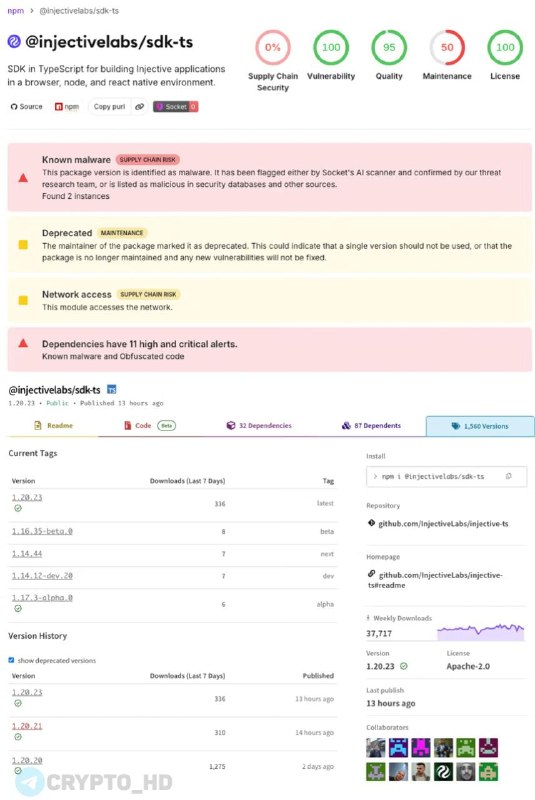
Attackers broke into a developer account and used it to publish a compromised version of Injective’s official toolkit. Developers use that toolkit to build wallets and DEXs. They also use it for DeFi apps, trading bots, and payment services on Injective. It gets about 50,000 downloads a week. The bad version touched 17 related Injective packages, which put at least 87 dependent packages at risk. Those packages have more than 112,000 cumulative downloads. The malware posed as technical statistics collection. In reality, it fired when a wallet was created or connected, grabbed seed phrases and private keys, and sent them to the attackers’ server. Ugly stuff. The compromised version stayed live for less than an hour, but it still picked up about 310 downloads. Small number? Not really. In crypto, one exposed developer machine can be enough.
The attack also gives the crypto “safe haven” debate a different problem to deal with, according to market analysts. Most safe haven arguments focus on outside shocks. That is only half right. Yes, BTC rising 8% during the January 2020 Soleimani strike still matters as a reference point, but this incident came from inside the tooling. If a core SDK can be poisoned, trust takes a hit before a price chart necessarily knows what to do with it. Investors may buy Bitcoin (BTC) during geopolitical uncertainty, then turn around and cut exposure to a major altcoin ecosystem after a security failure. That can mean smaller altcoins get sold first, while BTC or stablecoins look boring in the useful way. The bigger version of that fear showed up in May 2022, when the Terra/Luna collapse dragged BTC below $30,000 and ETH under $2,000. People were not just dumping one token. They were asking whether DeFi itself was built on shaky ground.
This matters for crypto adoption, too. More users means more targets. More institutions means more security reviews. Why does this matter? Because a corporation or bank looking at a DeFi protocol built on Injective would not brush this off just because the bad package disappeared quickly. I would not. Even a short breach can send a project back through vendor review, legal review, and risk review. That slows deals down. Sometimes it kills them. The price of BTC or ETH may barely move on a headline like this, but the damage can show up elsewhere: weaker capital inflows into altcoins, especially smaller projects that rely on shared packages and have thinner security records.
What this means
The warning is straightforward: attackers are moving upstream into crypto developer tools. This is no longer only about phishing links or hacked exchanges. They are going after the packages developers install before a product ever reaches users. Counter to the usual advice, watching only front-end exploits and exchange breaches misses the deeper problem. If a shared SDK is compromised, every app built on it can inherit the problem. Traders should be more careful with newer DeFi protocols. Same for apps that have not been audited closely. Injective (INJ) may avoid a sharp price drop because the fix came fast, but developer tool security now belongs in the risk picture. Smaller altcoins that depend heavily on third party packages may feel that pressure first.
The next thing to read is Injective’s official post mortem. It should explain how the account was breached, how the package made it through release, and what the team is changing. I’ll be honest: a vague post mortem would be worse than no post mortem for some investors. It is also worth watching audits and bug bounty programs for other major blockchain SDKs. Is this overkill? For a 50-page site, maybe. For infrastructure tied to wallets and private keys, no. One more incident like this, even a small one, could make the market price security risk more harshly. For portfolios, this is a reason to think twice about holding too much exposure to tightly connected altcoin ecosystems. Watch capital flows from Injective based DeFi apps. A real drop in total value locked (TVL), especially below $100 million, would suggest users are still nervous after the fix.
FAQ
What was the Injective NPM package backdoor attempt?
Attackers accessed a developer account and used it to publish a compromised version of Injective’s official SDK, specifically /sdk-ts 1.20.2. Short version: the trusted package channel became the attack path.
What was the malicious code trying to do?
The code pretended to collect technical statistics, but it was built to steal seed phrases and private keys when users created or connected wallets. It then sent that data to the attackers’ server. That is the whole nightmare.
How many packages were affected?
The infected version spread across 17 related Injective packages. At least 87 dependent packages, with more than 112,000 cumulative downloads, were put at risk.
How quickly was the compromised version removed?
It was available for less than an hour and was downloaded about 310 times before removal. Yes, this sounds contained. It still matters because developer-package compromise scales strangely fast.
What does this mean for crypto more broadly?
It shows that supply chain attacks against crypto infrastructure are getting harder to ignore. The risk is not theoretical. Bad code in a developer package can threaten user funds, DeFi apps, and institutional trust.
How does this relate to the “safe haven” debate in crypto?
Most safe haven arguments focus on geopolitical or macro events. This attack points to an internal problem: trust in the tools themselves. That kind of scare can push investors away from riskier altcoins and toward BTC or stablecoins.
What should traders and investors watch next?
Watch Injective’s post mortem, audits of other major SDKs, and any capital leaving Injective based apps. A meaningful drop in Total Value Locked (TVL) would show that users have not fully moved on.