















































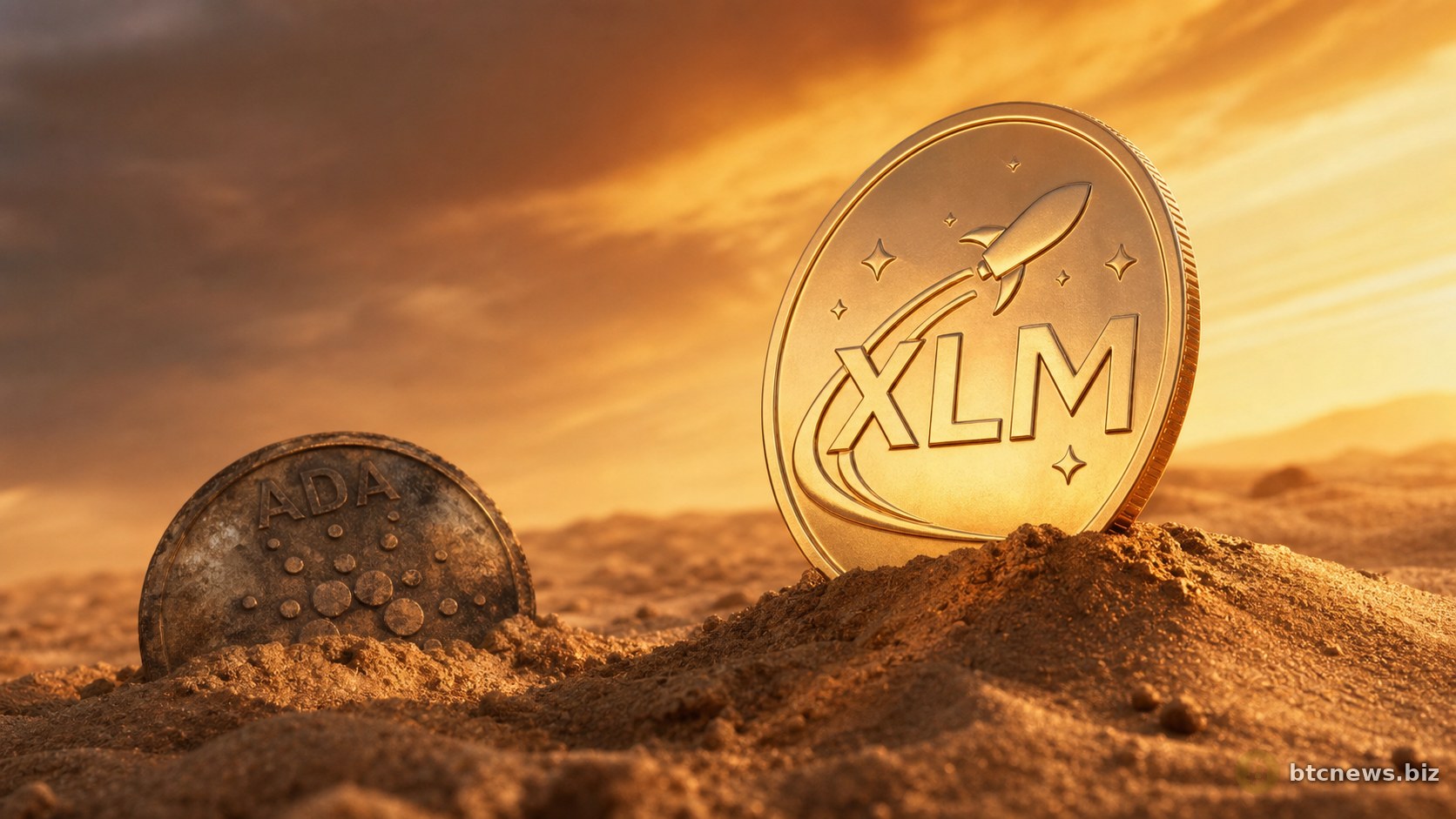
Why Cardano’s fall from the top 10 points to a different crypto market
Cardano dropping out of the top 10 says the quiet part plainly: traders want more proof. At press time, $ADA sat in 13th place with a market cap near $8 billion. $XLM had moved into the top 10 after hitting a record $10 billion. My take: that is not just leaderboard trivia. When the market gets defensive, capital gets picky fast.

The top 50 is less forgiving than it was in easier cycles. CoinMarketCap data cited in the source showed Hedera’s $HBAR rising to 18th as its market cap reached about $4.6 billion. Dogecoin is still the only memecoin in the top 20, while the memecoin sector has lost nearly 15% of its market cap this year. Traders still want upside. Obviously. But pure hype is getting a much shorter leash. Shorter than bulls want to admit.
Macro pressure is showing up in the rankings. In risk-off phases, investors often jump into shorter rotation trades. This time, the source says money is not mainly rushing into memecoins. Counter to the usual advice, this is not just another “risk comes back, memes pump” setup. $HBAR, at roughly $4.6 billion, and $XLM, at a record $10 billion, are climbing while traders look for networks with real use and visible activity. Why does this matter? Because rankings expose where liquidity is willing to wait, not just where social feeds are loud.
Brand recognition is not carrying tokens like it used to. That does not mean traders have suddenly become patient or wise. Please. It means liquidity is getting screened harder. $ADA falling to 13th, with a market cap around $8 billion, shows that a familiar name is not enough on its own. In earlier cycles, a big community and a known ticker could hold a ranking for longer. Right now, the table is colder: usage matters. Demand matters too. I would not overcomplicate it.
For traders, adoption is the signal worth watching. The source links the rise of $HBAR and $XLM to stronger activity and clearer utility. That is not the same as a memecoin liquidity chase. It is a bet on networks that can say more than “people are talking about us.” $XLM entering the top 10 at a record $10 billion is hard to ignore, especially while confidence around several large-cap tokens still looks shaky. Is that a full endorsement of utility coins? No. It is a market preference, and preferences can change.
Cardano’s bigger problem is confidence, not the number 13. Dropping out of the top 10 hurts, but the harder question is whether investors still believe the project can turn spending and development into growth. The source cites a recent X post where one analyst compared $ADA with Polkadot’s DOT, which fell from 7th to 37th after years of token inflation. The analyst said many holders felt the spending did not create enough growth. I’ll be honest: that comparison stings because crypto investors have watched this movie before.
Token inflation and treasury spending need visible results now. If supply rises, or money gets spent, and demand does not show up, the market eventually notices. Usually late, then all at once. In $ADA‘s case, the source treats its exit from the top 10 as support for AMBCrypto’s view that investors are rewarding activity and economic value over storylines. Most guides frame this as a fundamentals-versus-hype split. That is only half right. It is also about timing: in a tighter market, even decent stories need evidence sooner.
Cardano is not irrelevant. A fall to 13th place is not a collapse, and a roughly $8 billion market cap still puts Cardano among major crypto assets. But the burden of proof has moved. Bulls now have to show that Cardano can turn its community and development work into adoption people can measure. We can argue about whether the market is being fair. It rarely is. Traders may still give it time, but not forever.
The memecoin data makes the same point from another angle. With the sector down nearly 15% in market cap this year and Dogecoin still the only memecoin in the top 20, liquidity is no longer rewarding every high-beta trade the same way. That matters for BTC and ETH traders too, even if the source is focused on rankings. When capital leaves weaker speculative trades and moves toward utility-linked networks, the market usually becomes less patient with weak token design. Weak on-chain demand gets punished too.
The move can reverse. This is still crypto. Yes, this contradicts the hard-edged tone above a little. Bear with me. The top 50 table is still clearer than the usual social media noise. $HBAR at 18th, $XLM in the top 10, and $ADA at 13th are not random details. They show where liquidity is willing to sit when traders have less appetite for tokens running mostly on narrative.
What this means
The market is sorting networks by proof, not promises. $XLM at a record $10 billion and $HBAR around $4.6 billion suggest investors are putting more weight on utility and on-chain activity. $ADA, now 13th at about $8 billion, becomes the one to watch because losing top-10 status puts pressure on Cardano to show growth outside its own community. My read: the market is not asking for perfection. It is asking for receipts.
The next CoinMarketCap updates matter. Watch whether $ADA can get back into the top 10. Watch whether $XLM can hold near its record $10 billion market cap zone. Also watch Dogecoin’s place in the top 20 and the memecoin sector’s nearly 15% drop this year. If those patterns hold, this is not just a headline. It is capital rotation visible on the board.
FAQ
Q: What does Cardano’s fall from the top 10 mean?
A: It means the market is giving less credit to brand recognition and more credit to utility, adoption, and measurable economic value.
Q: Which cryptocurrencies are moving up in this market?
A: Stellar ($XLM) and Hedera ($HBAR) are moving up as traders put more weight on their perceived utility and on-chain activity.
Q: What happened to the memecoin sector?
A: The memecoin sector has lost nearly 15% of its market cap this year. Dogecoin remains the only memecoin in the top 20.
Q: What does this mean for Cardano ($ADA) now?
A: Cardano has to prove more. Bulls need visible adoption and measurable growth if they want investor confidence to recover.
Q: Is this a permanent change in crypto?
A: Not necessarily. Crypto rotations can flip fast. For now, though, the market is showing less patience for weak fundamentals and narrative-only trades.