
















































Japan Pension Fund Crypto Investment Points to Bigger Institutional Interest
Japan’s National Corporate Pension Fund plans to start investing in cryptocurrency this year. That is hard to shrug off. I’ll be honest: this is not the kind of headline I would treat as background noise. After nearly six years of watching the market, the fund seems ready to treat digital assets as something more durable than a speculative side bet, especially as it looks for ways to rely less on the US dollar.
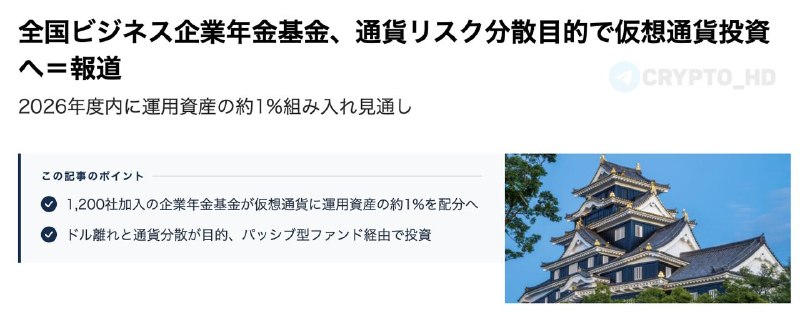
The fund represents about 1,200 companies and more than 20,000 employees across Japan. Its managers want to cut some dollar exposure because they think the dollar’s role as the world’s main reserve currency could weaken over time. Their research found that crypto markets have matured, with more investors and deeper liquidity. That does not make crypto safe. It matters anyway.
This is a serious adoption signal for crypto. Most guides say institutional adoption starts with banks and ETFs. That’s only half right. When a national pension fund tied to 1,200 companies and more than 20,000 workers puts money into digital assets, other investors pay attention. We have seen smaller signals before: MicroStrategy bought Bitcoin for its treasury in August 2020, and BTC moved from roughly $11,700 to more than $12,000 within days. This feels different. It is not one company making a treasury decision. It is a pension fund making a long term allocation. My take: that could make cautious institutions revisit rules they wrote when crypto still looked too thin, too volatile, or too politically awkward to touch. I would expect more discussion from pension funds and sovereign wealth funds over the next few months, especially around BTC and ETH.
The decision also fits the macro story around de-dollarization and rotation into risk assets. The fund said it wants to “reduce dependence on the dollar and diversify currency risks.” Why does this matter? Because that is not crypto-native language; it is portfolio-risk language. Central banks are still dealing with inflation, higher rates, and geopolitical stress, so the search for alternatives has not gone away. Bitcoin gets called “digital gold” so often that the phrase is worn out, but the idea still attracts capital. During the 2020 COVID shock, BTC fell near $5,000 in March and climbed above $28,000 by the end of the year. That run helped some investors see it as a non-sovereign asset. This Japanese pension fund seems to be making a similar bet: crypto may help hedge fiat depreciation and financial system risk.
The six-year research period is worth taking seriously. Skip this step. That is the advice some traders seem to want from every institutional crypto story, but it is exactly the wrong read here. This does not look like a quick trade. It looks like a slow allocation decision that took a lot of internal debate. The fund’s view that crypto has matured because more investors now participate gives the industry some institutional cover. That matters more than people like to admit. New money often waits for someone else to move first. Yes, this contradicts the usual crypto-market instinct to front-run everything; bear with me. In institutional markets, permission often matters as much as conviction. This probably is not only about Bitcoin, either. If the fund builds a diversified crypto position, Ethereum could be included because of its role in decentralized finance and its size in the market.
What this means
Japan’s National Corporate Pension Fund is treating crypto as a possible part of a diversified portfolio, not just a high-risk trade. That helps the long term case for Bitcoin (BTC) and Ethereum (ETH), especially for investors worried about fiat currency risk. The dollar-dependency angle is the part I keep coming back to. Large financial institutions are at least testing whether non-sovereign assets deserve a place in the portfolio. Is this overkill for one fund announcement? For a small corporate treasury, maybe. For a national pension fund connected to about 1,200 companies, no. If that view spreads, crypto could attract more sticky capital, meaning money that does not leave after the first ugly weekly candle. That kind of capital can make market structure more stable, but it will not remove volatility. Crypto is still crypto.
Traders should watch for similar announcements from other national pension funds or sovereign wealth funds. Another move of this size could move prices fast. For BTC, the $60,000 area remains important because institutional buying could help build support there. For ETH, the question is how it performs against BTC. A pension fund building a diversified crypto book may not stop at the largest asset. Counter to the usual advice, I would not watch only the headline allocation. Custody choices matter. Asset selection matters. Regulatory clarity and ETF approvals in other major economies could be the next major triggers because they make crypto easier for traditional finance to justify. The most useful update would be an official allocation breakdown from the Japanese fund itself. Percentages, custody choices, and asset selection would tell the market much more than the headline.