
















































Polymarket Polygon hack 520K tests prediction market trust
The “Polymarket Polygon hack 520k” refers to a reported incident where more than $520,000 was allegedly withdrawn from Polymarket’s UMA CTF Adapter on Polygon, according to ZachXBT.
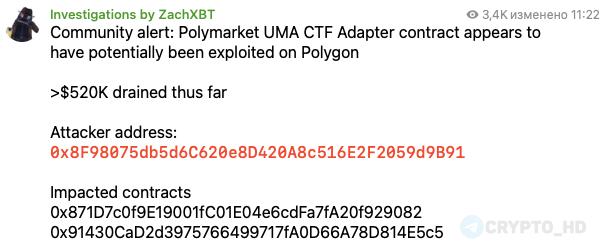
ZachXBT said a hacker withdrew over $520,000 from that adapter contract. That’s the hard claim. My take: do not stretch it into something bigger than the report supports. The report does not confirm that Polymarket accounts, the website, trading, or all user funds were compromised.
Polymarket uses the UMA CTF Adapter on Polygon as a bridge-like contract for paying winning positions, according to the article. Plain version: the reported issue sits in the payout contract, not across the entire Polymarket app. A $520,000 exploit is small next to the worst crypto blowups. Still, it is not pocket change. It works as a trust shock, especially because Polymarket sits near the center of the prediction market mainstreaming story.
The first market angle is regulation. Prediction markets already live in a messy zone between trading, information markets, event contracts, and wagering. Most guides would separate a contract exploit from the regulatory debate. That’s only half right. A Polygon contract exploit gives critics a clean headline, even if the report does not say accounts or trading were breached. For listed crypto proxies such as COIN, this is not an earnings hit. It is a confidence hit. When the story changes from “people are using on-chain markets” to “a payout contract got drained,” traders often sell first and read the contract details later. I’ll be honest: I do not love that habit, but it is real.
This matters for BTC and ETH because the market is still deciding whether crypto is a serious financial rail or a pile of smart contract risks wearing a better suit. BTC, trading near $76,000 on May 22, 2026, would not normally move much on a $520,000 app-layer exploit by itself. ETH and Polygon-linked risk are more exposed to this kind of headline. Why does this matter? Because the words settlement, adapters, bridges, and contract trust all point at the same uncomfortable question: can users trust the rails after a market resolves?
The second angle is adoption. Polymarket depends on users believing that markets settle cleanly and quickly, with enough transparency to remove doubt. A reported exploit of the UMA CTF Adapter on Polygon hits that belief directly. The article says there is no confirmation that accounts, the site, trading, or all user funds were hacked. That should limit the panic. Still, adoption is not driven only by final losses. It is driven by confidence. And $520,000 is enough money for active users to ask where contract risk ends and platform risk begins.
For Polygon, the read is bad but narrow. The source names Polygon as the chain hosting the UMA CTF Adapter contract, so traders will watch Polygon-linked liquidity and mood. Counter to the usual reaction, that does not mean the Polygon network failed, according to the source. The cleaner read is more specific: a contract Polymarket used for payout mechanics was reportedly exploited. Investors may now want more diligence before trusting similar on-chain settlement systems. Fair enough.
Macro flow is the third layer. Not the headline. Still relevant. Crypto risk appetite continues to react to interest rates, and the next scheduled FOMC decision is June 17, 2026, after the June 16-17 meeting. If BTC holds the $76,000 area into that date, traders may treat the Polymarket news as isolated infrastructure noise. If BTC breaks below that level before June 17, app-specific exploits like this can feed a broader risk-off move, especially in ETH, COIN, and Polygon-linked assets where regulation concerns already overlap with smart contract worries.
The editorial point is simple: do not overstate it. Yes, this contradicts the instinct to treat every crypto exploit as systemic. Bear with me. The source does not confirm hacked accounts, a compromised website, broken trading, or a hack of all Polymarket user funds. But “payout adapter” is still a phrase serious traders should care about. Prediction markets are only as credible as their resolution path and settlement path. A clean front end does not mean much if the contract behind payouts becomes the weak spot.
What this means
This event puts prediction markets through the kind of stress test DeFi went through years ago. Users want simple products. The risk often sits somewhere uglier: adapters, bridges, settlement contracts, and the handoff between them. Is this overkill for one reported $520,000 incident? For a market category trying to earn institutional trust, no. For BTC, the direct effect should stay limited unless the story grows beyond the $520,000 figure reported by ZachXBT. For ETH, COIN, and Polygon-linked risk, it lands harder because it feeds both the regulation trade and the smart contract discount.
Watch two things first: any clarification from Polymarket or UMA about the affected Polygon contract, and BTC’s behavior around $76,000 before the June 16-17, 2026 FOMC meeting, with the decision due June 17. We tried to keep the read narrow here because the reported facts are narrow. If BTC stays firm and no wider compromise is confirmed, traders may shrug this off. If new details show exposure to accounts, the site, trading, or broader user funds, the market will stop treating this as a $520,000 contract incident and start repricing prediction market infrastructure risk.