
















































Fear and greed index: stock neutral, crypto extreme fear
The Fear and Greed Index is not whispering the same thing in both markets. Stocks are at 48, basically neutral. Crypto is at 23, deep in “extreme fear.” My take: that spread matters more than either number on its own. Crypto traders look far more jumpy than stock investors right now. Maybe that means choppy price action. Maybe it means crypto is nearing one of those ugly washouts that looks obvious only after it is over. I would not call it bullish. I also would not ignore it.
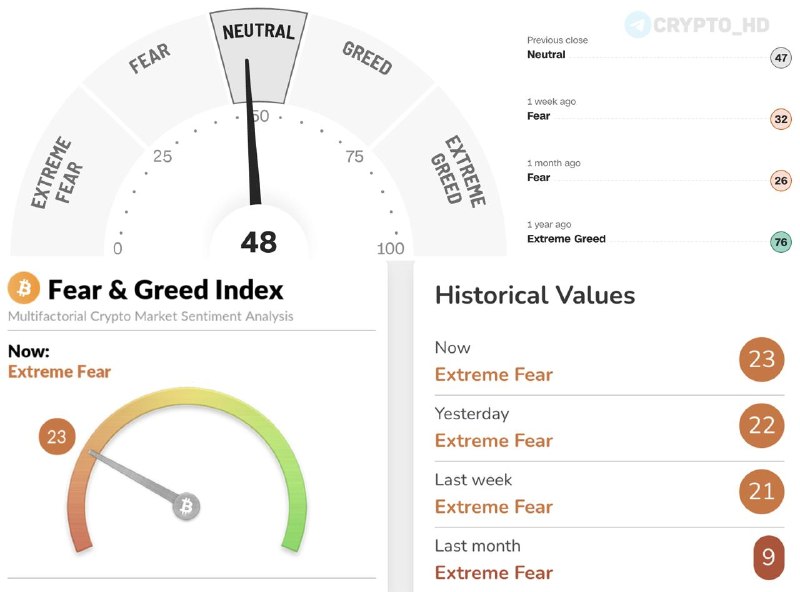
The stock reading is dull. That is the point. A 48 puts the traditional market almost dead center on the scale, with neither buyers nor sellers fully in control. Crypto is a different room with different lighting. A 23 usually means people are backing away, selling into weakness, or waiting for the noise to settle before buying again. That is not mild caution. That is fear.
Most market notes treat stocks and crypto as one big risk trade. That is only half right. Usually, if stocks hold up, crypto gets at least some help from the same appetite for risk, just with bigger swings. Not here. Money may be leaving crypto specifically. Or fresh money may simply be parked on the sidelines. Why does this matter? Because a gap between 48 and 23 says the stress is not evenly spread. This could be a delayed reaction to earlier rate pressure. It could also be large funds trimming exposure before another rough stretch. Late 2022 had a similar feel, when tougher Fed comments and broad risk aversion helped push BTC below $16,000. In plain English: crypto may still be digesting old macro pain, or it may have its own problem.
Regulation may be part of it too. I’ll be honest: this is where people often get too confident. The data source does not point to one specific regulatory event, so there is no reason to pretend we know the exact cause. Still, a 23 reading usually means traders are worried about something concrete. SEC scrutiny of staking programs has damaged sentiment before. So has uncertainty around spot Bitcoin ETF decisions. Legal fights involving major exchanges such as Coinbase have also made buyers hesitate. When regulators move closer, buyers tend to get cautious fast. The Ripple case is the clean example: after the SEC sued Ripple in December 2020, XRP fell more than 60% within days.
What this means
Crypto fear at 23 while stocks sit at 48 points to a real break in sentiment. This is not a tiny wobble. Crypto is under pressure that the stock market is not feeling in the same way, whether the cause is market structure, regulation, or leftover macro stress. Counter to the usual advice, I would not automatically treat extreme fear as a buy signal. For traders, it can set up a capitulation trade, but capitulation is an ugly place to operate. BTC and ETH will probably take most of the pressure because they still set the tone for everything smaller. I would watch whether BTC retests the $25,000 to $26,000 area, which has mattered as both technical and psychological support.
From here, the watch list is not complicated: inflation data, central bank comments, ETF news, major exchange cases. Is that overkill? No, because any one of those can push sentiment lower or give buyers a reason to return. Yes, this slightly contradicts the idea that no single cause is obvious. Bear with me: the cause may be unclear, but the triggers are still visible. For BTC, a sustained move below the 20 day moving average, currently around $27,500, would make the bearish case harder to dismiss and could leave room for more downside.