
















































Privacy Crypto Dev Activity: Santiment’s Top 10 Signals Market Shift
Santiment says ChainLink led privacy crypto developer activity over the past 30 days. Odd result, right? ChainLink is not the name most traders put beside Monero or Zcash. Still, it ranked above projects built much more directly around private transactions. I’ll be honest: I would not read this as a clean “buy LINK” signal. Crypto almost never works that neatly. What it does suggest is more interesting: privacy work is showing up in infrastructure, not only in coins that market anonymity as the whole product.
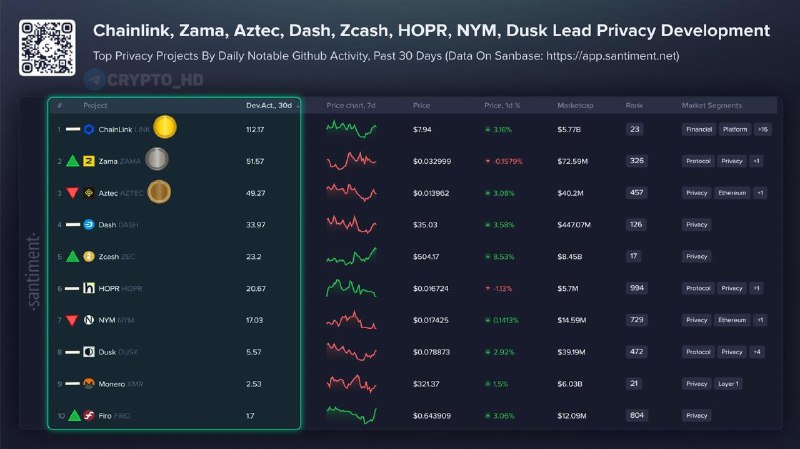
Developer activity is a useful way to see whether a crypto project still has builders around it. Santiment ranked the top 10 privacy oriented crypto projects by developer activity over the last 30 days. ChainLink came first, followed by Zama, Aztec, Dash, Zcash, HOPR, NYM, Dusk, Monero, and Firo. Some names fit immediately: Zcash, Monero, Dash. Others make the list feel less obvious. Good. That friction is the point. The ranking is a rough snapshot of where engineers are spending time in privacy crypto, and that is usually more useful than another Telegram pump story.
ChainLink’s ranking suggests privacy work may be moving into crypto’s plumbing. ChainLink is known for decentralized oracle infrastructure, not shielded payments or anonymous wallets. So its number one spot on a privacy oriented list is worth noticing. Most guides would frame privacy crypto as a coin category. That is only half right. It could also mean private data flows, app level privacy features, or infrastructure support for protocols that need privacy without becoming privacy coins. If institutions keep moving into crypto after spot Bitcoin ETFs won approval in 2024, they will need privacy that can live with compliance rules instead of pretending regulators are not there. Why does this matter? Because compliance friendly privacy is much easier to sell to banks, funds, and payment apps than pure anonymity. ChainLink could benefit if its infrastructure helps apps handle private transactions or sensitive off chain data. LINK does not automatically go up. Different claim.
Dedicated privacy projects are still building, even with regulators watching closely. The rest of Santiment’s list includes older privacy names like Dash, Zcash, and Monero. It also includes newer projects such as Zama and Aztec. My take: that mix matters more than the exact order. People still want transactional privacy. Maybe quietly. Maybe not in a form every exchange wants to list. But demand has not disappeared. Pressure from agencies like the SEC and groups like the Financial Action Task Force can still hit liquidity, listings, short term prices, and market access. We saw that in 2021 and 2022, when privacy coins often sold off after crackdowns or exchange restrictions. Counter to the usual advice, steady development does not have to show up in price right away to matter. It can simply keep the project alive. Monero, for instance, has often traded by its own logic when privacy becomes a hotter topic.
What this means
Santiment’s report points to a wider meaning of privacy in crypto. Privacy no longer means only coins like Monero or Zcash. It can also mean infrastructure that lets DeFi apps, Web3 services, data networks, and oracle systems share information without exposing everything by default. Honestly, that is the practical version of the story. Most users do not want to inspect privacy architecture. They want apps that do not leak every detail of their financial life. Is this less exciting than a pure privacy coin narrative? Yes. It may also be more durable. If projects like ChainLink help make that possible, privacy becomes part of the stack instead of a separate niche.
Investors should watch what actually ships. Developer activity matters, but commits are not products. Watch whether ChainLink announces integrations with privacy focused protocols or releases new privacy related features. For Zcash, Monero, Dash, and similar projects, the harder question is whether they can stay useful while exchanges and regulators keep tightening the rules. FATF guidance on virtual assets still matters, especially for liquidity and listings. I would also watch whether privacy projects turn development work into real usage. A busy GitHub chart is fine. Users matter more. Skip the shortcut.
FAQ
Q: What is the main takeaway from Santiment’s report on privacy crypto dev activity?
A: ChainLink led Santiment’s privacy related developer activity ranking for the past 30 days, even though people do not usually think of it as a privacy coin. That suggests privacy work may be spreading into crypto infrastructure.
Q: Why is ChainLink’s top ranking significant?
A: ChainLink’s ranking suggests privacy may be becoming part of the wider crypto stack. This is less about one coin promising anonymity and more about infrastructure that can support private data and transactions across apps.
Q: How does developer activity relate to a crypto project’s long term viability?
A: Developer activity shows whether people are still working on a project. It does not prove adoption or price growth. Still, a dead repo is usually a bad sign.
Q: What does the report suggest about the future of privacy in crypto?
A: It suggests privacy is becoming less isolated. Instead of living only inside dedicated privacy coins, it may become a normal feature in DeFi, Web3 apps, and crypto infrastructure.
Q: Should investors prioritize privacy coins or infrastructure projects like ChainLink for privacy exposure?
A: They offer different kinds of exposure. Privacy coins are the more direct bet on anonymity. Infrastructure projects like ChainLink may benefit if privacy becomes something many crypto apps need under the hood.
Q: How do regulatory pressures affect privacy crypto development?
A: Regulation can hurt exchange listings, liquidity, short term prices, and access to major trading venues. The continued developer activity shows builders have not walked away from privacy, even with that pressure.
Q: What role do institutional investors play in the demand for privacy solutions?
A: Institutions usually need privacy and compliance at the same time. That can push demand toward systems that protect sensitive data without making regulation impossible.
Q: What are some established privacy coins mentioned in the report?
A: Santiment’s list included Dash, Zcash, and Monero, all older privacy focused projects that still showed developer activity during the measured 30 day period.
Q: How can investors monitor the progress of privacy focused projects?
A: Watch product releases, integrations, exchange listings, liquidity, and real usage. Developer activity matters, but it should lead somewhere visible.
Q: What is Santiment?
A: Santiment is a crypto analytics firm that tracks on chain, social, and development metrics. Its developer activity rankings are one way to see which projects still have active engineering work behind them.