
















































Zcash BTC Correlation Flashes Red as Traders Watch Volatility
The Zcash BTC correlation is flashing as a risk signal. That is the part I would not wave away. It compares ZEC strength with how Bitcoin has behaved near past turning points, and CryptoQuant says traders are watching it again because earlier Zcash pumps have often appeared around major BTC inflection points. Does that mean ZEC has some secret read on Bitcoin? No. It means the Zcash risk indicator is back in the red zone, and CryptoQuant links that reading to higher volatility plus possible pressure on the trend.
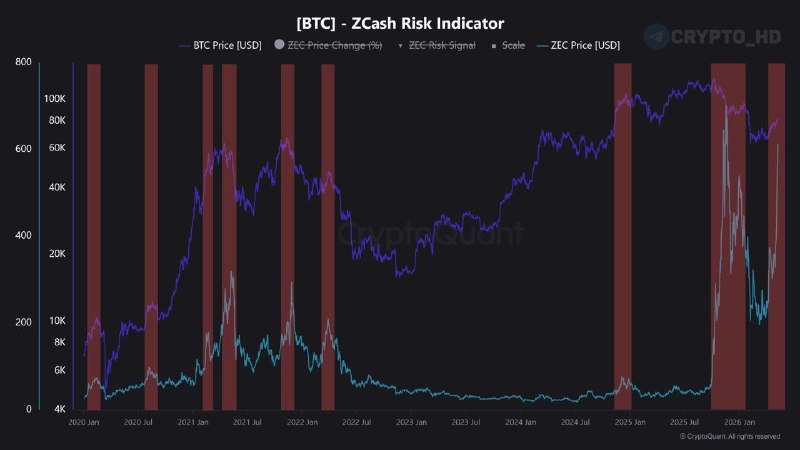
The clean read is blunt: CryptoQuant treats Zcash strength as a volatility warning, not a Bitcoin prediction machine. Most market notes turn this kind of thing into a lead-lag story. That is only half right here. The post does not say Zcash will lead Bitcoin. It does not give a ZEC price target. It says ZEC strength has often shown up when BTC was either running hot or trying to recover from a nasty drawdown. My take: this is less a tidy ZEC price prediction based on Bitcoin correlation and more a reason to check positioning before BTC and Zcash start moving hard.
Bitcoin still drives most crypto macro flow. Traders usually express risk-on or risk-off views through BTC first, then rotate into smaller, higher beta names like ZEC. The two reference points are still rough but useful: BTC near $69,000 in November 2021, then near $15,500 in November 2022 during the FTX mess. Those dates matter. “Overheating” and “deep drawdown” are not just labels; they describe two completely different market moods. CryptoQuant’s post, though, does not connect the current Zcash signal to a specific BTC price.
The safe haven angle is more of a side read, and I would keep it there. Bitcoin and privacy coins do not trade on the same story. BTC often gets pulled into gold comparisons during political stress or banking stress. Currency pressure can do it too. Zcash is different. Privacy coins move more on anonymity, optionality, fast speculation, and the occasional privacy narrative flare-up. CryptoQuant only discusses BTC and Zcash. It does not bring in gold, war, sanctions, the Fed, or inflation. Still, when a privacy-linked coin starts moving while BTC may be near a turn, traders will ask what the market is reaching for: protection, leverage, or just a clean volatility trade.
ZEC Bitcoin correlation only helps if traders separate two setups. If ZEC rallies while BTC is stalling near a hot zone, that can look like late-cycle risk appetite. If ZEC rallies while BTC is recovering from a deep washout, that can look like early risk moving back into smaller narratives. Yes, that sounds like two opposite reads from the same signal. Bear with me. CryptoQuant leaves both possibilities open, and that is probably the fairest way to read it. The red-zone Zcash risk indicator deserves attention, not blind faith.
The most accurate read is simple: possible elevated volatility, not a confirmed reversal. There is not much hidden language to decode beyond the CryptoQuant post itself. The words that matter are “red zone” and “possible elevated volatility.” Not “confirmed reversal.” Why does this matter? Because traders still do not need certainty before cutting leverage or tightening stops. Sometimes a warning light is enough to make you look at BTC and ZEC exposure before the market makes that choice for you.
What this means

The Zcash risk indicator suggests the market may be closer to a trend decision than a quiet grind. For BTC, the question is whether momentum is tiring or setting up for a rebound. For Zcash, the question is whether ZEC is really warning about Bitcoin or just having its own privacy coin run that fades after a few sessions. I’ll be honest: the second outcome is very possible.
The practical move is to watch BTC and ZEC together, not separately. Counter to the usual advice, the point is not to add more indicators until the chart looks scientific. The next things worth checking are BTC spot momentum, whether ZEC keeps moving after the red-zone signal, CME Bitcoin futures positioning, and the Federal Reserve rate decision on June 17, 2026. The Fed’s 2026 FOMC calendar lists the June meeting for June 16-17, with the decision due June 17. Is this overkill? For active traders, no. If BTC breaks a major technical level while the Zcash risk indicator stays hot, active traders will have a harder time brushing this off.
FAQ
What is the Zcash BTC correlation?
The Zcash BTC correlation is the relationship between ZEC price action and Bitcoin’s market direction. Traders watch it to see whether Zcash strength supports BTC momentum, warns against it, or is moving on its own.
Why is the Zcash risk indicator in focus?
CryptoQuant says the Zcash risk indicator is in the red zone, a reading tied to possible higher volatility. It matters because earlier Zcash pumps have often appeared near major Bitcoin turning points.
Does the red-zone Zcash signal predict a Bitcoin reversal?
No. The signal points to possible volatility and trend risk. It does not confirm a Bitcoin reversal.
Is this a ZEC price prediction?
No. CryptoQuant does not give a ZEC price target or say Zcash will outperform Bitcoin.
How should traders use the Zcash BTC correlation?
Traders can use the Zcash BTC correlation as a reason to review risk. In my view, it works best when checked against BTC momentum, ZEC follow-through, futures positioning, and macro dates.
Why does Bitcoin matter more than Zcash for macro crypto flow?
Bitcoin is still the main crypto benchmark. Market-wide risk appetite usually shows up in BTC first, while higher beta assets like ZEC often react after BTC direction looks clearer.
What could confirm the Zcash signal?
Stronger confirmation would be sustained ZEC follow-through alongside a major BTC technical break or rebound. Without BTC confirmation, the move may stay limited to Zcash or privacy coins.
What is the next macro date traders are watching?
The Federal Reserve’s 2026 FOMC calendar lists the next relevant Fed decision date as June 17, 2026. Rate decisions can shift risk appetite across Bitcoin and higher beta crypto assets.